Atomic number
Atomic number is a fundamental concept in chemistry and physics, representing the number of protons found in the nucleus of an atom. It is denoted by the symbol Z.
Definition[edit]
The atomic number of an atom is equal to the number of protons in its nucleus. This number is unique for each element and determines the identity of the element. For example, the atomic number of hydrogen is 1, while that of oxygen is 8.
History[edit]
The concept of atomic number was first proposed by the British physicist Henry Moseley in 1913. Moseley's work demonstrated that the atomic number is more fundamental than the atomic weight in characterizing the properties of an element.
Significance[edit]
The atomic number is crucial in determining the chemical properties of an element. It defines the element's position in the periodic table, and it also determines the number of electrons in a neutral atom, which in turn influences the atom's ability to form chemical bonds.
Determination[edit]
The atomic number of an element can be determined using various techniques, such as spectroscopy and mass spectrometry. These methods rely on the unique spectral lines or mass-to-charge ratios associated with each element.
See also[edit]

 | This physics-related article is a stub. You can help WikiMD by expanding the page. |
-
Atomic number depiction
-
Dmitri Mendeleev's Cabinet
-
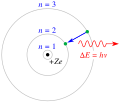 Bohr atom model
 -
Henry Moseley


Medical Disclaimer: WikiMD is for informational purposes only and is not a substitute for professional medical advice. Content may be inaccurate or outdated and should not be used for diagnosis or treatment. Always consult your healthcare provider for medical decisions. Verify information with trusted sources such as CDC.gov and NIH.gov. By using this site, you agree that WikiMD is not liable for any outcomes related to its content. See full disclaimer.
Credits:Most images are courtesy of Wikimedia commons, and templates, categories Wikipedia, licensed under CC BY SA or similar.
Translate page: - East Asian
中文,
日本,
한국어,
South Asian
हिन्दी,
தமிழ்,
తెలుగు,
Urdu,
ಕನ್ನಡ,
Southeast Asian
Indonesian,
Vietnamese,
Thai,
မြန်မာဘာသာ,
বাংলা
European
español,
Deutsch,
français,
Greek,
português do Brasil,
polski,
română,
русский,
Nederlands,
norsk,
svenska,
suomi,
Italian
Middle Eastern & African
عربى,
Turkish,
Persian,
Hebrew,
Afrikaans,
isiZulu,
Kiswahili,
Other
Bulgarian,
Hungarian,
Czech,
Swedish,
മലയാളം,
मराठी,
ਪੰਜਾਬੀ,
ગુજરાતી,
Portuguese,
Ukrainian


