File:Batesplate ArM.jpg
Original file (1,200 × 1,024 pixels, file size: 591 KB, MIME type: image/jpeg)
Summary[edit]
| Summary | |
|---|---|
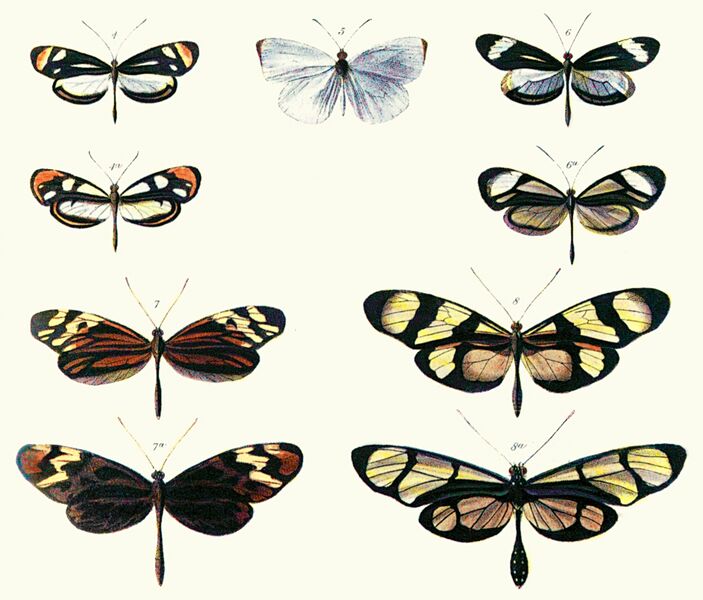
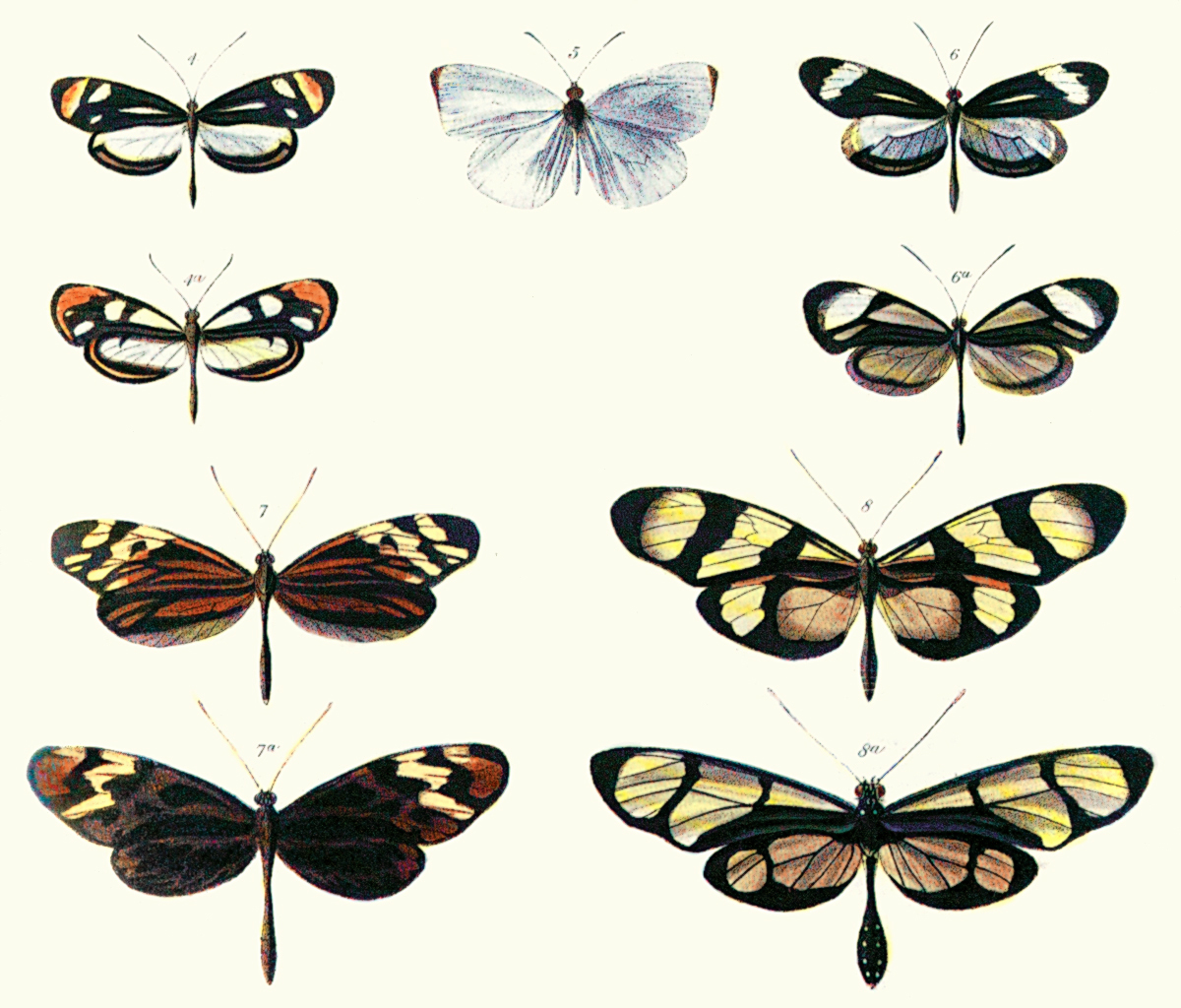
| Description | Plate illustrating Batesian mimicry between Dismorphia species (top row, third row) and various Ithomiini (Nymphalidae) (second row, bottom row)
Plate LVI. Fig. 1. Leptalis Theonoë, var. Erythroë.— St. Paulo, 69° W. long. Fig. 2. Leptalis Theonoë, var. Erythroë.— St. Paulo. Fig. 3. Leptalis Theonoë, var. Erythroë.— St. Paulo. Fig. 3 a. Ithomia Orolina, var. Chrysodonia.— St. Paulo. The linking variations between L. Erythroë and Theonoë can be traced through the varieties 8, 5, and 6 of the preceding Plate. The substitution of red for white in the fore wings is seen to be a simple variation. Some traces of the narrowing of the red margin of the hind wing are also seen. The imitation of Ithomia is not nearly so close as it is in the cases of figs. 1 and 2 of the preceding and fig. 4 of the present Plate, but there is a considerable approximation, giving the appearance of a striving after a correct imitation. The selection of individuals having the most faithful likeness is here either not rigid or we see the formation of an exact mimetic analogue in process. Fig. 4. Leptalis Theonoë, var. Leuconoë.— St. Paulo. Fig. 4a. Ithomia Ilerdina (Hewitson).— St. Paulo. This Leptalis appears at first sight an absolutely distinct species, but it is plainly a modification whose adaptation is complete. As to the fore wings, the vacillating nature of the colours is seen in figs. 4, 6, and 8 of Plate LV. in the clearest manner. The hind wings appear very peculiar, on account of the milky colour; but this is shown to arise by variation in Ithomiæ, which exhibit all the grades of variation from dusky to white nervures and ground of the hind wing. Fig. 5. Leptalis Nehemia (of authors). — New Granada and S. Brazil. Figured to show the normal form of the family (Pieridæ, called in England "Garden White" Butterflies) to which Leptalis belongs. The contrast in form and colours points to the conclusion that all the other forms of Leptalis are perverted from the usual facies of the family by long-continued process of adaptation to the Heliconidæ, in whose company (each species with its Heliconian model) they are solely found. Fig. 6. Leptalis Theonoë, var. Argochloë. — St. Paulo. Fig. 6 a. Ithomia Virginia (Hewits.). — St. Paulo. The links of modification may be traced also with respect to this apparently distinct Leptalis. The shape of the spot of the fore wing is seen to be very variable in figs. 1, 2, 3 of this Plate, and in 9 and 4 of Plate LV. Fig. 7- Leptalis Amphione, var. Egaëna. — Ega. Fig. 7a. Mechanitis Polymnia, var. Egaënsis. — Ega. Fig. 8. Leptalis Orise (Boisduval). — Cuparí, 55° W. long.; also Cayenne. Fig. 8a. Methona Psidii (Linnæus). — Cuparí; also Cayenne.— Bates, Henry Walter, in: [1] |
| Source | Wikimedia Commons |
| Author | Henry Walter Bates |
| Permission | See Commons |
Licensing[edit]
Public Domain
This file is in the public domain and may be used without restriction.
Please see the linked source page for the original file history, attribution information, and licensing details.
Original attribution and file history: Wikimedia Commons
File history
Click on a date/time to view the file as it appeared at that time.
| Date/Time | Thumbnail | Dimensions | User | Comment | |
|---|---|---|---|---|---|
| current | 01:20, 2 June 2026 | | 1,200 × 1,024 (591 KB) | Maintenance script (talk | contribs) | == Summary == Importing file |
You cannot overwrite this file.
File usage
The following file is a duplicate of this file (more details):
- File:Batesplate ArM.jpg from Wikimedia Commons
The following 2 pages use this file: