Haloarchaea
Haloarchaea or haloarchaeota are a class of the Euryarchaeota, found in water saturated or nearly saturated with salt. They are also called halophiles, though this name is also used for other organisms which live in somewhat less concentrated salt water. They are common in salt flats.
Characteristics[edit]
Haloarchaea can grow in concentrations of salts that would kill most other organisms. They are so dependent on salt for their survival, that they cannot grow in the absence of salt. They are aerobic, and they breathe oxygen.
Classification[edit]
Haloarchaea were originally classified as a group of bacteria. However, their unusual characteristics and genomics have led them to be classified as a separate, third domain of life, the Archaea.
Metabolism[edit]
Haloarchaea are capable of photosynthesis. They use a purple pigment for this process, which is similar to the one used by purple bacteria, and different from the green pigment used by plants and cyanobacteria.
Reproduction[edit]
Haloarchaea reproduce asexually by binary fission, fragmentation, or budding; unlike bacteria, no species forms spores.
See also[edit]
References[edit]
External links[edit]

This WikiMD article can only be edited by registered and verified editors. You can log in or register.
Haloarchaea[edit]
-
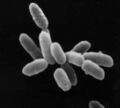 Halobacteria
 -
San Francisco Bay Salt Ponds


Medical Disclaimer: WikiMD is for informational purposes only and is not a substitute for professional medical advice. Content may be inaccurate or outdated and should not be used for diagnosis or treatment. Always consult your healthcare provider for medical decisions. Verify information with trusted sources such as CDC.gov and NIH.gov. By using this site, you agree that WikiMD is not liable for any outcomes related to its content. See full disclaimer.
Credits:Most images are courtesy of Wikimedia commons, and templates, categories Wikipedia, licensed under CC BY SA or similar.
Translate page: - East Asian
中文,
日本,
한국어,
South Asian
हिन्दी,
தமிழ்,
తెలుగు,
Urdu,
ಕನ್ನಡ,
Southeast Asian
Indonesian,
Vietnamese,
Thai,
မြန်မာဘာသာ,
বাংলা
European
español,
Deutsch,
français,
Greek,
português do Brasil,
polski,
română,
русский,
Nederlands,
norsk,
svenska,
suomi,
Italian
Middle Eastern & African
عربى,
Turkish,
Persian,
Hebrew,
Afrikaans,
isiZulu,
Kiswahili,
Other
Bulgarian,
Hungarian,
Czech,
Swedish,
മലയാളം,
मराठी,
ਪੰਜਾਬੀ,
ગુજરાતી,
Portuguese,
Ukrainian


