Oxaloacetic acid
Oxaloacetic acid (also known as OAA) is a four-carbon molecule found in all living organisms. It is a key intermediate in various metabolic pathways, including the citric acid cycle, gluconeogenesis, and the alanine cycle.
Structure and properties[edit]
Oxaloacetic acid is a carboxylic acid with the chemical formula C4H4O5. It has a molecular weight of 132.07 g/mol. The molecule consists of a ketone group and two carboxylic acid groups. The pKa values of the carboxylic acid groups are 2.22 and 3.13, respectively.
Role in metabolism[edit]
Oxaloacetic acid plays a crucial role in several metabolic pathways. In the citric acid cycle, it combines with acetyl-CoA to form citric acid, which is then metabolized to produce energy. In gluconeogenesis, oxaloacetic acid is a key intermediate in the conversion of non-carbohydrate substrates into glucose. In the alanine cycle, it is converted into aspartic acid.
Synthesis[edit]
In biological systems, oxaloacetic acid is synthesized from pyruvic acid by the enzyme pyruvate carboxylase. It can also be synthesized from phosphoenolpyruvic acid by the enzyme phosphoenolpyruvate carboxykinase.
See also[edit]

This WikiMD article can only be edited by registered and verified editors. You can log in or register.
Oxaloacetic_acid[edit]
-
Oxaloacetate tautomerase
-
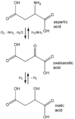 Oxaloacetate and malic acid
 -
Oxaloacetate and pyruvate amino acid synthesis


Medical Disclaimer: WikiMD is for informational purposes only and is not a substitute for professional medical advice. Content may be inaccurate or outdated and should not be used for diagnosis or treatment. Always consult your healthcare provider for medical decisions. Verify information with trusted sources such as CDC.gov and NIH.gov. By using this site, you agree that WikiMD is not liable for any outcomes related to its content. See full disclaimer.
Credits:Most images are courtesy of Wikimedia commons, and templates, categories Wikipedia, licensed under CC BY SA or similar.
Translate page: - East Asian
中文,
日本,
한국어,
South Asian
हिन्दी,
தமிழ்,
తెలుగు,
Urdu,
ಕನ್ನಡ,
Southeast Asian
Indonesian,
Vietnamese,
Thai,
မြန်မာဘာသာ,
বাংলা
European
español,
Deutsch,
français,
Greek,
português do Brasil,
polski,
română,
русский,
Nederlands,
norsk,
svenska,
suomi,
Italian
Middle Eastern & African
عربى,
Turkish,
Persian,
Hebrew,
Afrikaans,
isiZulu,
Kiswahili,
Other
Bulgarian,
Hungarian,
Czech,
Swedish,
മലയാളം,
मराठी,
ਪੰਜਾਬੀ,
ગુજરાતી,
Portuguese,
Ukrainian


