Primitive streak
The Primitive Streak is a structure that forms in the blastula during the early stages of avian, reptilian, and mammalian embryonic development. It establishes bilateral symmetry, determines the site of gastrulation and initiates germ layer formation. The primitive streak is the earliest trace of the embryo in the fertilized ovum.
Formation[edit]
The primitive streak forms during the third week of embryogenesis. It begins as a small area of epiblastic cells at the caudal end of the embryonic disc. These cells proliferate and migrate towards the cranial end of the disc, forming a raised streak. This process is known as gastrulation.
Function[edit]
The primitive streak serves several key functions in embryonic development. It establishes the longitudinal axis of the embryo and determines the bilateral symmetry of the organism. It also serves as the site of gastrulation, the process by which the three germ layers (ectoderm, mesoderm, and endoderm) are formed.
Clinical Significance[edit]
Abnormalities in the formation of the primitive streak can lead to a variety of congenital disorders. These include caudal dysgenesis, sirenomelia, and situs inversus. In addition, the primitive streak is the site of origin for teratomas, a type of germ cell tumor.
See Also[edit]
References[edit]

This WikiMD article can only be edited by registered and verified editors. You can log in or register.
Primitive streak[edit]
-
Gray13a
-
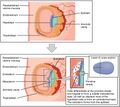 2908 Germ Layers-02
 -
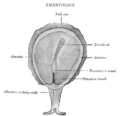 Gray14
 -
Formation of the Primitive Streak
-
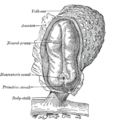 Gray17
 -
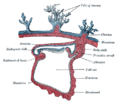 Gray21


Medical Disclaimer: WikiMD is for informational purposes only and is not a substitute for professional medical advice. Content may be inaccurate or outdated and should not be used for diagnosis or treatment. Always consult your healthcare provider for medical decisions. Verify information with trusted sources such as CDC.gov and NIH.gov. By using this site, you agree that WikiMD is not liable for any outcomes related to its content. See full disclaimer.
Credits:Most images are courtesy of Wikimedia commons, and templates, categories Wikipedia, licensed under CC BY SA or similar.
Translate page: - East Asian
中文,
日本,
한국어,
South Asian
हिन्दी,
தமிழ்,
తెలుగు,
Urdu,
ಕನ್ನಡ,
Southeast Asian
Indonesian,
Vietnamese,
Thai,
မြန်မာဘာသာ,
বাংলা
European
español,
Deutsch,
français,
Greek,
português do Brasil,
polski,
română,
русский,
Nederlands,
norsk,
svenska,
suomi,
Italian
Middle Eastern & African
عربى,
Turkish,
Persian,
Hebrew,
Afrikaans,
isiZulu,
Kiswahili,
Other
Bulgarian,
Hungarian,
Czech,
Swedish,
മലയാളം,
मराठी,
ਪੰਜਾਬੀ,
ગુજરાતી,
Portuguese,
Ukrainian


