Promyelocyte
A promyelocyte is a type of cell that is found in the bone marrow and is an important component of the body's immune system. It is classified as an intermediate stage in the development of white blood cells, specifically granulocytes, which are responsible for fighting off infections and foreign substances in the body.
Structure[edit]
Promyelocytes are characterized by their large size and distinct appearance under a microscope. They have a round or oval-shaped nucleus, which contains genetic material, and a relatively large amount of cytoplasm. The cytoplasm of a promyelocyte is rich in granules, which are small vesicles that contain enzymes and other substances involved in immune responses.
Function[edit]
The main function of promyelocytes is to differentiate into mature granulocytes, such as neutrophils, eosinophils, and basophils. This process is known as granulopoiesis and occurs in the bone marrow. During granulopoiesis, promyelocytes undergo several stages of maturation, gradually acquiring specific characteristics and functions.
Clinical Significance[edit]
Abnormalities in promyelocyte development can lead to various health conditions. For example, an increased number of promyelocytes in the blood may indicate a condition called promyelocytic leukemia, a type of acute myeloid leukemia. In this condition, the promyelocytes fail to mature properly and accumulate in the bone marrow and blood, interfering with normal blood cell production.
References[edit]
See Also[edit]
-
Promyelocyte
-
Peripheral blood smear of acute promyelocytic leukemia, hypogranular variant
-
 Cytology of acute promyelocytic leukemia, annotated
 -
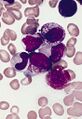 Faggot cell in AML-M3
 -
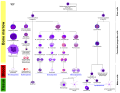 Hematopoiesis (human) diagram
 -
Basophilic promyelocyte
-
Eosonophilic promyelocyte
-
Neutrophilic promyelocyte


_diagram_en.svg)

Medical Disclaimer: WikiMD is for informational purposes only and is not a substitute for professional medical advice. Content may be inaccurate or outdated and should not be used for diagnosis or treatment. Always consult your healthcare provider for medical decisions. Verify information with trusted sources such as CDC.gov and NIH.gov. By using this site, you agree that WikiMD is not liable for any outcomes related to its content. See full disclaimer.
Credits:Most images are courtesy of Wikimedia commons, and templates, categories Wikipedia, licensed under CC BY SA or similar.
Translate page: - East Asian
中文,
日本,
한국어,
South Asian
हिन्दी,
தமிழ்,
తెలుగు,
Urdu,
ಕನ್ನಡ,
Southeast Asian
Indonesian,
Vietnamese,
Thai,
မြန်မာဘာသာ,
বাংলা
European
español,
Deutsch,
français,
Greek,
português do Brasil,
polski,
română,
русский,
Nederlands,
norsk,
svenska,
suomi,
Italian
Middle Eastern & African
عربى,
Turkish,
Persian,
Hebrew,
Afrikaans,
isiZulu,
Kiswahili,
Other
Bulgarian,
Hungarian,
Czech,
Swedish,
മലയാളം,
मराठी,
ਪੰਜਾਬੀ,
ગુજરાતી,
Portuguese,
Ukrainian


.jpg)


