Ribose
Ribose is a carbohydrate that plays a crucial role in the formation of RNA, DNA, and ATP. It is a monosaccharide with the chemical formula C5H10O5. Ribose is a key component of several important biomolecules, including nucleic acids and nucleotides.
Structure[edit]
Ribose is a pentose sugar, meaning it has five carbon atoms. It has a linear form and a ring form, with the ring form being more stable and therefore more common. The ring form of ribose is a furanose, a five-membered ring with four carbon atoms and one oxygen atom.
Biological role[edit]
Ribose is a critical component of several important biomolecules. It forms the backbone of RNA, where it links together nucleotides to form the RNA strand. In DNA, a related sugar called deoxyribose performs a similar function. Ribose is also a component of ATP, the main energy currency of the cell, as well as other important biomolecules like coenzyme A, NADH, and FAD.
Synthesis[edit]
In cells, ribose is synthesized from glucose through the pentose phosphate pathway. This pathway also produces NADPH, a molecule important for redox reactions in the cell.
Clinical significance[edit]
Because of its role in energy production, ribose has been studied as a potential treatment for conditions like chronic fatigue syndrome and fibromyalgia. However, the evidence for its effectiveness is mixed, and more research is needed.
See also[edit]

This WikiMD article can only be edited by registered and verified editors. You can log in or register.
Ribose[edit]
-
Fischer Projection of L-Ribose
-
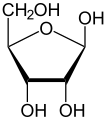 Beta-D-Ribofuranose
 -
D-рибоза
-
L-рибоза
-
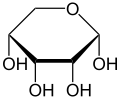 Alpha-D-Ribopyranose
 -
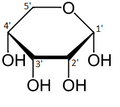 Alpha-D-Ribopyranose numbered
 -
Beta-D-Ribopyranose numbered
-
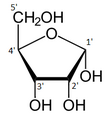 Alpha-D-Ribofuranose numbered
 -
Beta-D-Ribofuranose Numbered
-
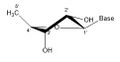 2' endo
 -
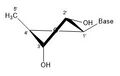 2' endo 3' exo
 -
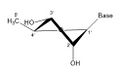 3' endo 2' exo


Medical Disclaimer: WikiMD is for informational purposes only and is not a substitute for professional medical advice. Content may be inaccurate or outdated and should not be used for diagnosis or treatment. Always consult your healthcare provider for medical decisions. Verify information with trusted sources such as CDC.gov and NIH.gov. By using this site, you agree that WikiMD is not liable for any outcomes related to its content. See full disclaimer.
Credits:Most images are courtesy of Wikimedia commons, and templates, categories Wikipedia, licensed under CC BY SA or similar.
Translate page: - East Asian
中文,
日本,
한국어,
South Asian
हिन्दी,
தமிழ்,
తెలుగు,
Urdu,
ಕನ್ನಡ,
Southeast Asian
Indonesian,
Vietnamese,
Thai,
မြန်မာဘာသာ,
বাংলা
European
español,
Deutsch,
français,
Greek,
português do Brasil,
polski,
română,
русский,
Nederlands,
norsk,
svenska,
suomi,
Italian
Middle Eastern & African
عربى,
Turkish,
Persian,
Hebrew,
Afrikaans,
isiZulu,
Kiswahili,
Other
Bulgarian,
Hungarian,
Czech,
Swedish,
മലയാളം,
मराठी,
ਪੰਜਾਬੀ,
ગુજરાતી,
Portuguese,
Ukrainian


