Pterygopalatine ganglion
Pterygopalatine ganglion (also known as the sphenopalatine ganglion) is one of the four parasympathetic ganglia of the head and neck. It is the largest of the ganglia and is associated with the maxillary nerve.
Anatomy[edit]
The pterygopalatine ganglion is located in the pterygopalatine fossa, posterior to the middle nasal turbinate and anterior to the pterygoid canal. It is triangular in shape and is suspended by two roots from the maxillary nerve and pterygoid canal.
Function[edit]
The pterygopalatine ganglion supplies parasympathetic fibers to the lacrimal gland and mucous glands of the nasal cavity, palate, and pharynx. It also carries sensory fibers from the nasal cavity, palate, and pharynx to the maxillary nerve.
Clinical significance[edit]
The pterygopalatine ganglion is involved in various clinical conditions such as cluster headache, trigeminal neuralgia, and sphenopalatine ganglion neuralgia. It can be targeted for sphenopalatine ganglion block or sphenopalatine ganglion stimulation in the treatment of these conditions.
See also[edit]
- Parasympathetic ganglia
- Maxillary nerve
- Pterygopalatine fossa
- Sphenopalatine ganglion block
- Sphenopalatine ganglion stimulation
References[edit]

This WikiMD article can only be edited by registered and verified editors. You can log in or register.
-
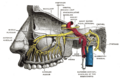 Diagram of the pterygopalatine ganglion and its connections.
 -
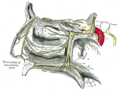 The maxillary nerve and its branches.
 -
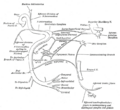 The pterygopalatine fossa and its contents.
 -
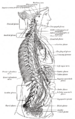 The distribution of the maxillary nerve.
 -
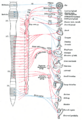 The pterygopalatine ganglion and its branches.
 -
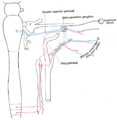 The pterygopalatine ganglion and its connections.
 -
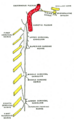 The pterygopalatine ganglion and its branches.
 -
 Diagram of the maxillary nerve system.
 -
 Autonomic innervation to the lacrimal gland and other glands of the deep face.


.svg)

Medical Disclaimer: WikiMD is for informational purposes only and is not a substitute for professional medical advice. Content may be inaccurate or outdated and should not be used for diagnosis or treatment. Always consult your healthcare provider for medical decisions. Verify information with trusted sources such as CDC.gov and NIH.gov. By using this site, you agree that WikiMD is not liable for any outcomes related to its content. See full disclaimer.
Credits:Most images are courtesy of Wikimedia commons, and templates, categories Wikipedia, licensed under CC BY SA or similar.
Translate page: - East Asian
中文,
日本,
한국어,
South Asian
हिन्दी,
தமிழ்,
తెలుగు,
Urdu,
ಕನ್ನಡ,
Southeast Asian
Indonesian,
Vietnamese,
Thai,
မြန်မာဘာသာ,
বাংলা
European
español,
Deutsch,
français,
Greek,
português do Brasil,
polski,
română,
русский,
Nederlands,
norsk,
svenska,
suomi,
Italian
Middle Eastern & African
عربى,
Turkish,
Persian,
Hebrew,
Afrikaans,
isiZulu,
Kiswahili,
Other
Bulgarian,
Hungarian,
Czech,
Swedish,
മലയാളം,
मराठी,
ਪੰਜਾਬੀ,
ગુજરાતી,
Portuguese,
Ukrainian

