Adipose tissue
Adipose tissue is a specialized connective tissue that plays a critical role in energy storage, insulation, and cushioning of the body. It is primarily composed of adipocytes, which are cells that store fat in the form of triglycerides. Adipose tissue is found throughout the body and is classified into two main types: white adipose tissue and brown adipose tissue.
Structure[edit]
Adipose tissue is a type of connective tissue that consists of adipocytes, fibroblasts, macrophages, and endothelial cells. The adipocytes are the predominant cell type and are responsible for storing energy in the form of fat. These cells are characterized by a large lipid droplet that occupies most of the cell volume, pushing the nucleus to the periphery.
White Adipose Tissue[edit]
White adipose tissue (WAT) is the most abundant form of adipose tissue in the body. It serves as the primary site for energy storage and is involved in the regulation of metabolism. WAT is distributed throughout the body, with significant deposits in the subcutaneous layer, around internal organs, and in the abdominal region.
Brown Adipose Tissue[edit]
Brown adipose tissue (BAT) is less abundant than white adipose tissue and is primarily involved in thermogenesis, the process of heat production. BAT contains a higher number of mitochondria, which gives it a brown color. It is mainly found in newborns and in small amounts in adults.

Function[edit]
Adipose tissue serves several important functions in the body:
- Energy Storage: Adipose tissue stores energy in the form of triglycerides, which can be mobilized during periods of energy deficit.
- Insulation: It provides thermal insulation, helping to maintain body temperature.
- Cushioning: Adipose tissue acts as a cushion, protecting internal organs from mechanical damage.
- Endocrine Function: Adipose tissue secretes hormones such as leptin, adiponectin, and resistin, which play roles in appetite regulation, insulin sensitivity, and inflammation.
Clinical Significance[edit]
Excessive accumulation of adipose tissue can lead to obesity, which is associated with various health conditions such as type 2 diabetes, cardiovascular disease, and metabolic syndrome. Abdominal obesity, in particular, is a significant risk factor for these conditions.
Related pages[edit]
Gallery[edit]
-
Fat mouse
-
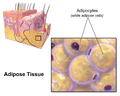 Diagram of adipose tissue
 -
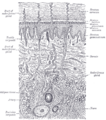 Gray's anatomy illustration of adipose tissue
 -
 Yellow adipose tissue in paraffin section
 -
Body fat meter


Medical Disclaimer: WikiMD is for informational purposes only and is not a substitute for professional medical advice. Content may be inaccurate or outdated and should not be used for diagnosis or treatment. Always consult your healthcare provider for medical decisions. Verify information with trusted sources such as CDC.gov and NIH.gov. By using this site, you agree that WikiMD is not liable for any outcomes related to its content. See full disclaimer.
Credits:Most images are courtesy of Wikimedia commons, and templates, categories Wikipedia, licensed under CC BY SA or similar.
Translate page: - East Asian
中文,
日本,
한국어,
South Asian
हिन्दी,
தமிழ்,
తెలుగు,
Urdu,
ಕನ್ನಡ,
Southeast Asian
Indonesian,
Vietnamese,
Thai,
မြန်မာဘာသာ,
বাংলা
European
español,
Deutsch,
français,
Greek,
português do Brasil,
polski,
română,
русский,
Nederlands,
norsk,
svenska,
suomi,
Italian
Middle Eastern & African
عربى,
Turkish,
Persian,
Hebrew,
Afrikaans,
isiZulu,
Kiswahili,
Other
Bulgarian,
Hungarian,
Czech,
Swedish,
മലയാളം,
मराठी,
ਪੰਜਾਬੀ,
ગુજરાતી,
Portuguese,
Ukrainian


