Bicarbonate buffer system
Bicarbonate Buffer System[edit]
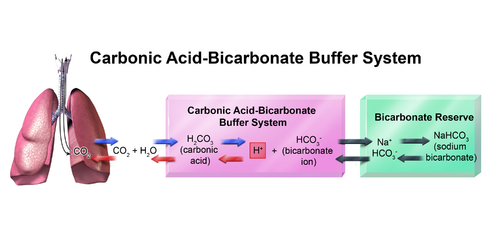
The bicarbonate buffer system is a crucial pH-regulating system in the blood. It plays a vital role in maintaining the acid-base balance in the body by absorbing carbon dioxide (CO2) and helping to stabilize pH levels.
Function[edit]
The primary function of the bicarbonate buffer system is to:
- Control the levels of carbon dioxide and bicarbonate in the blood.
- Regulate the pH of blood and other bodily fluids, ensuring they remain within the narrow range necessary for normal physiological processes.
Mechanism[edit]
The system operates through a chemical equilibrium process involving carbon dioxide (CO2), water (H2O), carbonic acid (H2CO3), bicarbonate ion (HCO3−), and hydrogen ion (H+):
1. CO2 from cellular respiration dissolves in the blood. 2. It reacts with water to form carbonic acid (H2CO3), a reaction catalyzed by the enzyme carbonic anhydrase. 3. Carbonic acid quickly dissociates into bicarbonate (HCO3−) and hydrogen ions (H+). 4. This reaction can proceed in both directions, either forming more H+ and HCO3− or recombining them to produce carbonic acid, which then forms CO2 and water.
Role in Acid-Base Balance[edit]
The bicarbonate buffer system helps maintain acid-base balance by:
- Responding to and neutralizing excess acids or bases in the body.
- Working in conjunction with other buffer systems, respiratory regulation, and renal mechanisms to control body pH.
Clinical Significance[edit]
Imbalances in the bicarbonate buffer system can lead to:
- Acidosis: Occurs when blood becomes too acidic, often due to an excess of CO2 or a decrease in bicarbonate.
- Alkalosis: Occurs when blood becomes too basic, often due to excessive loss of CO2 or an increase in bicarbonate.
Regulation[edit]
The body regulates the bicarbonate buffer system through:
- Respiratory mechanisms: Adjusting the rate and depth of breathing to control CO2 levels.
- Renal mechanisms: The kidneys regulate the excretion or retention of bicarbonate.
Importance in Health and Disease[edit]
Understanding and monitoring the bicarbonate buffer system is important in:
- Diagnosing and treating respiratory and metabolic disorders.
- Managing patients with chronic conditions like COPD or kidney disease.


Medical Disclaimer: WikiMD is for informational purposes only and is not a substitute for professional medical advice. Content may be inaccurate or outdated and should not be used for diagnosis or treatment. Always consult your healthcare provider for medical decisions. Verify information with trusted sources such as CDC.gov and NIH.gov. By using this site, you agree that WikiMD is not liable for any outcomes related to its content. See full disclaimer.
Credits:Most images are courtesy of Wikimedia commons, and templates, categories Wikipedia, licensed under CC BY SA or similar.
Translate page: - East Asian
中文,
日本,
한국어,
South Asian
हिन्दी,
தமிழ்,
తెలుగు,
Urdu,
ಕನ್ನಡ,
Southeast Asian
Indonesian,
Vietnamese,
Thai,
မြန်မာဘာသာ,
বাংলা
European
español,
Deutsch,
français,
Greek,
português do Brasil,
polski,
română,
русский,
Nederlands,
norsk,
svenska,
suomi,
Italian
Middle Eastern & African
عربى,
Turkish,
Persian,
Hebrew,
Afrikaans,
isiZulu,
Kiswahili,
Other
Bulgarian,
Hungarian,
Czech,
Swedish,
മലയാളം,
मराठी,
ਪੰਜਾਬੀ,
ગુજરાતી,
Portuguese,
Ukrainian

