Biliary tract
The biliary tract, also known as the biliary tree, is a system of organs and ducts that participate in the production, storage, and transportation of bile. Bile, a fluid produced by the liver, aids in the digestion of lipids in the small intestine. The biliary tract includes the gallbladder and the bile ducts.
Anatomy[edit]
The biliary tract consists of the gallbladder and the bile ducts. The bile ducts are classified into two main types: the intrahepatic bile ducts and the extrahepatic bile ducts. The intrahepatic bile ducts are located within the liver, while the extrahepatic bile ducts are located outside the liver.
Function[edit]
The primary function of the biliary tract is to facilitate the digestion of lipids in the small intestine. This is achieved through the production, storage, and transportation of bile, a fluid that contains bile acids, which are critical for the digestion and absorption of dietary fats.
Diseases[edit]
Diseases of the biliary tract can lead to severe health problems. These include gallstones, cholangitis, and cancer of the biliary tract. Gallstones are hard, pebble-like deposits that can form in the gallbladder or bile ducts. Cholangitis is an infection of the bile ducts, often caused by bacteria. Cancer of the biliary tract is a rare but serious condition that can lead to life-threatening complications.
Treatment[edit]
Treatment for biliary tract diseases varies depending on the specific condition and its severity. Treatments may include medication, lifestyle changes, or surgery. In some cases, a cholecystectomy, or removal of the gallbladder, may be necessary.
See also[edit]

 | This medical article is a stub. You can help WikiMD by expanding the page. |
Biliary_tract[edit]
-
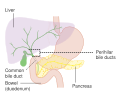 Diagram showing the position of the perihilar bile ducts
 -
Diagram showing the bile ducts in the pancreas


Medical Disclaimer: WikiMD is for informational purposes only and is not a substitute for professional medical advice. Content may be inaccurate or outdated and should not be used for diagnosis or treatment. Always consult your healthcare provider for medical decisions. Verify information with trusted sources such as CDC.gov and NIH.gov. By using this site, you agree that WikiMD is not liable for any outcomes related to its content. See full disclaimer.
Credits:Most images are courtesy of Wikimedia commons, and templates, categories Wikipedia, licensed under CC BY SA or similar.
Translate page: - East Asian
中文,
日本,
한국어,
South Asian
हिन्दी,
தமிழ்,
తెలుగు,
Urdu,
ಕನ್ನಡ,
Southeast Asian
Indonesian,
Vietnamese,
Thai,
မြန်မာဘာသာ,
বাংলা
European
español,
Deutsch,
français,
Greek,
português do Brasil,
polski,
română,
русский,
Nederlands,
norsk,
svenska,
suomi,
Italian
Middle Eastern & African
عربى,
Turkish,
Persian,
Hebrew,
Afrikaans,
isiZulu,
Kiswahili,
Other
Bulgarian,
Hungarian,
Czech,
Swedish,
മലയാളം,
मराठी,
ਪੰਜਾਬੀ,
ગુજરાતી,
Portuguese,
Ukrainian


