Blister beetle
Blister Beetle is a type of insect belonging to the family Meloidae. The name "blister beetle" comes from the insect's defensive secretion of a blistering agent, cantharidin. This substance is used in the medical field and is known to cause skin blisters on contact.
Biology and Behavior[edit]
Blister beetles are known for their unique life cycle, which involves a process known as hypermetamorphosis. This process allows the larvae to change their shape and behavior in response to changing environments. The adult beetles are plant-eating insects that can be found on flowers and leaves.
Distribution and Habitat[edit]
Blister beetles are found worldwide, but are most common in the tropical regions and desert environments. They are adaptable and can be found in a variety of habitats, including grasslands, forests, and agricultural fields.
Human Interaction[edit]
While blister beetles are not typically dangerous, they can cause skin irritation and blisters if handled. The beetles secrete cantharidin, a potent blistering agent, when they feel threatened. This substance can cause severe skin reactions and should be avoided.
Medical Use[edit]
The blistering agent, cantharidin, is used in the medical field for the removal of warts and other skin conditions. It is a potent and effective treatment, but must be used with caution due to its potential to cause skin irritation and blisters.
Conservation Status[edit]
The conservation status of blister beetles varies by species. Some species are common and widespread, while others are rare and may be threatened or endangered.
See Also[edit]
 | This insect-related article is a stub. You can help WikiMD by expanding the page. |
Blister beetle[edit]
-
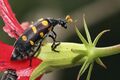 Hycleus lugens, Meloidae
 -
Blister beetle macrogiants A
-
Colletes hederae parasitized
-
Blister beetle chase
-
Black blister beetle
-
Cysteodemus armatus - Inflated Beetle Mojave desert
-
Green insect on hand
-
Ölkäfer Meloë violaceus
-
Mylabris quadripunctata
-
Meloidae Actenodia CMR beetle
-
Horia sal
-
Sitaris muralis


Medical Disclaimer: WikiMD is for informational purposes only and is not a substitute for professional medical advice. Content may be inaccurate or outdated and should not be used for diagnosis or treatment. Always consult your healthcare provider for medical decisions. Verify information with trusted sources such as CDC.gov and NIH.gov. By using this site, you agree that WikiMD is not liable for any outcomes related to its content. See full disclaimer.
Credits:Most images are courtesy of Wikimedia commons, and templates, categories Wikipedia, licensed under CC BY SA or similar.
Translate page: - East Asian
中文,
日本,
한국어,
South Asian
हिन्दी,
தமிழ்,
తెలుగు,
Urdu,
ಕನ್ನಡ,
Southeast Asian
Indonesian,
Vietnamese,
Thai,
မြန်မာဘာသာ,
বাংলা
European
español,
Deutsch,
français,
Greek,
português do Brasil,
polski,
română,
русский,
Nederlands,
norsk,
svenska,
suomi,
Italian
Middle Eastern & African
عربى,
Turkish,
Persian,
Hebrew,
Afrikaans,
isiZulu,
Kiswahili,
Other
Bulgarian,
Hungarian,
Czech,
Swedish,
മലയാളം,
मराठी,
ਪੰਜਾਬੀ,
ગુજરાતી,
Portuguese,
Ukrainian


.jpg)


