Bruneian cuisine
Bruneian cuisine is a style of cooking and food preparation originating from Brunei. It is heavily influenced by the cuisines of Malaysia, Indonesia, China, and India, due to the country's historical and geographical connections.
Overview[edit]
Bruneian cuisine is often spicy and flavorful, with rice as a staple food. The cuisine is notable for its variety of flavors and ingredients, which include a wide range of spices, herbs, and tropical fruits.
Common Dishes[edit]
Some of the most popular dishes in Bruneian cuisine include:
- Ambuyat: A traditional Bruneian dish made from the interior trunk of the sago palm. It is often served with a sour fruit sauce called candas or a spicy sauce called binjai.
- Nasi Katok: A simple dish consisting of rice, fried chicken, and sambal (a hot sauce made from a mixture of chili peppers and other ingredients).
- Nasi Lemak: A fragrant rice dish cooked in coconut milk and pandan leaf, often served with anchovies, peanuts, boiled eggs, lamb curry, cucumber, and sambal.
Influences[edit]
Bruneian cuisine has been influenced by the cuisines of several different countries. The use of spices and coconut milk in many dishes reflects the influence of Indian cuisine and Malay cuisine. The use of wok for frying and the inclusion of ingredients like tofu and soy sauce are indicative of Chinese cuisine influence.
Eating Customs[edit]
In Brunei, it is customary to eat with the hands rather than with utensils, although utensils are used for certain dishes. Meals are typically served family-style, with all dishes placed in the center of the table for everyone to share.
See Also[edit]

Bruneian_cuisine[edit]
-
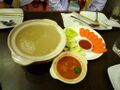 Ambuyat in Bandar Seri Begawan, Brunei
 -
 Coconut milk


Medical Disclaimer: WikiMD is for informational purposes only and is not a substitute for professional medical advice. Content may be inaccurate or outdated and should not be used for diagnosis or treatment. Always consult your healthcare provider for medical decisions. Verify information with trusted sources such as CDC.gov and NIH.gov. By using this site, you agree that WikiMD is not liable for any outcomes related to its content. See full disclaimer.
Credits:Most images are courtesy of Wikimedia commons, and templates, categories Wikipedia, licensed under CC BY SA or similar.
Translate page: - East Asian
中文,
日本,
한국어,
South Asian
हिन्दी,
தமிழ்,
తెలుగు,
Urdu,
ಕನ್ನಡ,
Southeast Asian
Indonesian,
Vietnamese,
Thai,
မြန်မာဘာသာ,
বাংলা
European
español,
Deutsch,
français,
Greek,
português do Brasil,
polski,
română,
русский,
Nederlands,
norsk,
svenska,
suomi,
Italian
Middle Eastern & African
عربى,
Turkish,
Persian,
Hebrew,
Afrikaans,
isiZulu,
Kiswahili,
Other
Bulgarian,
Hungarian,
Czech,
Swedish,
മലയാളം,
मराठी,
ਪੰਜਾਬੀ,
ગુજરાતી,
Portuguese,
Ukrainian

