Charoset
Charoset (also spelled Haroset), is a sweet, dark-colored, paste made of fruits and nuts eaten at the Passover Seder. Its color and texture are meant to recall mortar (or mud used to make adobe bricks) which the Israelites used when they were enslaved in Ancient Egypt as mentioned in the Book of Exodus of the Hebrew Bible. The word "charoset" comes from the Hebrew word cheres — חרס — "clay."
Charoset is one of the symbolic foods on the Passover Seder Plate. After reciting the blessings, and eating a matzah "sandwich" made with charoset and maror (bitter herbs), the remainder is often eaten plain, spread onto matzah.
Ingredients and Preparation[edit]
Charoset's ingredients may vary, depending on the culture and tradition of each Jewish community. The basic ingredients include nuts, fruits (usually apples or dates), cinnamon, and sweet red wine. Ashkenazi, Sephardic, and Mizrahi Jews have distinct recipes for charoset.
Ashkenazi Jews traditionally make apple-walnut charoset, while Sephardic Jews often use figs or dates and add different spices. Mizrahi Jews from Eastern countries like Iran and Iraq traditionally use dates as the base of their charoset.
Symbolism[edit]
Charoset serves a dual purpose in the Passover Seder. Its sweetness serves to counteract the bitterness of the maror, symbolizing the sweetness of freedom following the bitterness of slavery. At the same time, its texture is a reminder of the hard labor endured by the Israelites in Egypt.
See Also[edit]
 | This Jewish article is a stub. You can help WikiMD by expanding the page. |
This Jewish-related article is a stub. You can help WikiMD by expanding it.

-
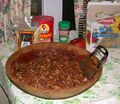 Charoset
 -
Charoset ingredients
-
Charoset served on Passover


Medical Disclaimer: WikiMD is for informational purposes only and is not a substitute for professional medical advice. Content may be inaccurate or outdated and should not be used for diagnosis or treatment. Always consult your healthcare provider for medical decisions. Verify information with trusted sources such as CDC.gov and NIH.gov. By using this site, you agree that WikiMD is not liable for any outcomes related to its content. See full disclaimer.
Credits:Most images are courtesy of Wikimedia commons, and templates, categories Wikipedia, licensed under CC BY SA or similar.
Translate page: - East Asian
中文,
日本,
한국어,
South Asian
हिन्दी,
தமிழ்,
తెలుగు,
Urdu,
ಕನ್ನಡ,
Southeast Asian
Indonesian,
Vietnamese,
Thai,
မြန်မာဘာသာ,
বাংলা
European
español,
Deutsch,
français,
Greek,
português do Brasil,
polski,
română,
русский,
Nederlands,
norsk,
svenska,
suomi,
Italian
Middle Eastern & African
عربى,
Turkish,
Persian,
Hebrew,
Afrikaans,
isiZulu,
Kiswahili,
Other
Bulgarian,
Hungarian,
Czech,
Swedish,
മലയാളം,
मराठी,
ਪੰਜਾਬੀ,
ગુજરાતી,
Portuguese,
Ukrainian


