Cisterna chyli
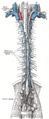
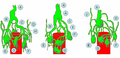
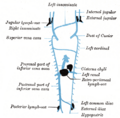
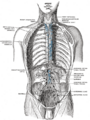
Cisterna chyli is a dilated sac at the lower end of the thoracic duct in most mammals into which lymph from the intestinal trunk and two lumbar lymphatic trunks flow. It receives fatty chyle, thus having a milky appearance, and delivers the chyle into the bloodstream via the left subclavian vein. The cisterna chyli is a retro-peritoneal structure.
Etymology[edit]
The term "cisterna chyli" originates from the Latin cisterna meaning "reservoir" and the Greek chyli meaning "juice".
Structure[edit]
The cisterna chyli is located posterior to the aorta on the anterior aspect of the bodies of the first and second lumbar vertebrae. It is formed by the union of the right and left lumbar trunks and the intestinal trunk, forming a significant pathway in the lymphatic system.
Function[edit]
The primary function of the cisterna chyli is to receive lymph from the lower half of the body and from the left side of the body above the diaphragm. This lymph is then transported to the thoracic duct, which carries it to the bloodstream.
Clinical significance[edit]
The cisterna chyli can be used as a marker in imaging studies to identify abnormal lymphatic drainage patterns, particularly in cases of lymphedema. It can also be involved in certain medical conditions such as chylothorax and lymphangioma.
See also[edit]
References[edit]

This WikiMD article can only be edited by registered and verified editors. You can log in or register.
-
 Cisterna chyli
 -
 Cisterna chyli
 -
 Cisterna chyli
 -
 Cisterna chyli
 -
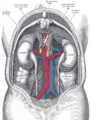 Cisterna chyli


Medical Disclaimer: WikiMD is for informational purposes only and is not a substitute for professional medical advice. Content may be inaccurate or outdated and should not be used for diagnosis or treatment. Always consult your healthcare provider for medical decisions. Verify information with trusted sources such as CDC.gov and NIH.gov. By using this site, you agree that WikiMD is not liable for any outcomes related to its content. See full disclaimer.
Credits:Most images are courtesy of Wikimedia commons, and templates, categories Wikipedia, licensed under CC BY SA or similar.
Translate page: - East Asian
中文,
日本,
한국어,
South Asian
हिन्दी,
தமிழ்,
తెలుగు,
Urdu,
ಕನ್ನಡ,
Southeast Asian
Indonesian,
Vietnamese,
Thai,
မြန်မာဘာသာ,
বাংলা
European
español,
Deutsch,
français,
Greek,
português do Brasil,
polski,
română,
русский,
Nederlands,
norsk,
svenska,
suomi,
Italian
Middle Eastern & African
عربى,
Turkish,
Persian,
Hebrew,
Afrikaans,
isiZulu,
Kiswahili,
Other
Bulgarian,
Hungarian,
Czech,
Swedish,
മലയാളം,
मराठी,
ਪੰਜਾਬੀ,
ગુજરાતી,
Portuguese,
Ukrainian

