Duodenum
Duodenum[edit]
The duodenum is the first section of the small intestine in most higher vertebrates, including humans. It is a hollow jointed tube connecting the stomach to the jejunum.
Anatomy[edit]

The duodenum is approximately 25–30 cm (10–12 inches) long and is shaped like a "C". It is divided into four parts:
- The superior part
- The descending part
- The horizontal part
- The ascending part
The duodenum is located in the upper abdomen and is mostly retroperitoneal, meaning it is located behind the peritoneum.
Histology[edit]
The duodenum has a unique histological structure that includes:
- Villi: Finger-like projections that increase the surface area for absorption.
- Microvilli: Microscopic projections on the surface of the villi.
- Brunner's glands: Located in the submucosa, these glands secrete an alkaline mucus that helps neutralize gastric acid.
Function[edit]
The primary function of the duodenum is to receive the chyme from the stomach and continue the process of digestion. It also plays a crucial role in:
- Neutralizing stomach acid
- Mixing chyme with digestive juices from the pancreas and bile from the liver
- Absorbing nutrients such as iron and calcium
Clinical Significance[edit]
The duodenum can be affected by various diseases and conditions, including:
- Duodenal ulcer: A common form of peptic ulcer disease.
- Celiac disease: An autoimmune disorder affecting the small intestine.
- Giardiasis: An infection caused by the parasite Giardia lamblia.
Development[edit]
The duodenum develops from the foregut and midgut during embryogenesis. It is initially a solid cord of cells that later becomes a hollow tube.
Related Pages[edit]
Gallery[edit]
-
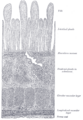 Diagram showing the position of the duodenum in the digestive system.
 -
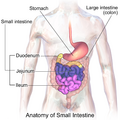 Anatomy of the small intestine, including the duodenum.
 -
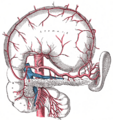 Illustration of the duodenum and its relation to surrounding organs.


Medical Disclaimer: WikiMD is for informational purposes only and is not a substitute for professional medical advice. Content may be inaccurate or outdated and should not be used for diagnosis or treatment. Always consult your healthcare provider for medical decisions. Verify information with trusted sources such as CDC.gov and NIH.gov. By using this site, you agree that WikiMD is not liable for any outcomes related to its content. See full disclaimer.
Credits:Most images are courtesy of Wikimedia commons, and templates, categories Wikipedia, licensed under CC BY SA or similar.
Translate page: - East Asian
中文,
日本,
한국어,
South Asian
हिन्दी,
தமிழ்,
తెలుగు,
Urdu,
ಕನ್ನಡ,
Southeast Asian
Indonesian,
Vietnamese,
Thai,
မြန်မာဘာသာ,
বাংলা
European
español,
Deutsch,
français,
Greek,
português do Brasil,
polski,
română,
русский,
Nederlands,
norsk,
svenska,
suomi,
Italian
Middle Eastern & African
عربى,
Turkish,
Persian,
Hebrew,
Afrikaans,
isiZulu,
Kiswahili,
Other
Bulgarian,
Hungarian,
Czech,
Swedish,
മലയാളം,
मराठी,
ਪੰਜਾਬੀ,
ગુજરાતી,
Portuguese,
Ukrainian


