Facial artery
Facial artery (previously known as the external maxillary artery in older texts) is a branch of the external carotid artery that supplies structures of the face.
Anatomy[edit]
The facial artery arises in the carotid triangle from the external carotid artery a little above the lingual artery and, sheltered by the ramus of the mandible, it passes obliquely up beneath the digastric muscle and stylohyoid muscle, over which it arches to enter a groove on the posterior surface of the submandibular gland.
Branches[edit]
The branches of the facial artery are as follows:
- The ascending palatine artery
- The tonsillar branch
- The glandular branches
- The submental artery
- The inferior labial artery
- The superior labial artery
- The lateral nasal branch
- The angular artery
Clinical significance[edit]
The pulse of the facial artery can be felt and examined by pressing it against the lower border of the mandible. The facial artery is often used by surgeons as a point of reference to find the facial nerve during parotid gland surgeries.
See also[edit]
References[edit]
External links[edit]
- Diagram at dartmouth.edu

This WikiMD article can only be edited by registered and verified editors. You can log in or register.
-
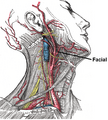 Facial artery diagram
 -
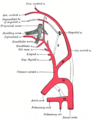 Anatomy of the facial artery
 -
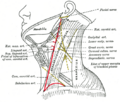 Branches of the facial artery
 -
 Facial artery


Medical Disclaimer: WikiMD is for informational purposes only and is not a substitute for professional medical advice. Content may be inaccurate or outdated and should not be used for diagnosis or treatment. Always consult your healthcare provider for medical decisions. Verify information with trusted sources such as CDC.gov and NIH.gov. By using this site, you agree that WikiMD is not liable for any outcomes related to its content. See full disclaimer.
Credits:Most images are courtesy of Wikimedia commons, and templates, categories Wikipedia, licensed under CC BY SA or similar.
Translate page: - East Asian
中文,
日本,
한국어,
South Asian
हिन्दी,
தமிழ்,
తెలుగు,
Urdu,
ಕನ್ನಡ,
Southeast Asian
Indonesian,
Vietnamese,
Thai,
မြန်မာဘာသာ,
বাংলা
European
español,
Deutsch,
français,
Greek,
português do Brasil,
polski,
română,
русский,
Nederlands,
norsk,
svenska,
suomi,
Italian
Middle Eastern & African
عربى,
Turkish,
Persian,
Hebrew,
Afrikaans,
isiZulu,
Kiswahili,
Other
Bulgarian,
Hungarian,
Czech,
Swedish,
മലയാളം,
मराठी,
ਪੰਜਾਬੀ,
ગુજરાતી,
Portuguese,
Ukrainian

