Falciform ligament
Falciform ligament is a thin, crescent-shaped ligament that attaches the liver to the anterior abdominal wall and the diaphragm. It is a remnant of the umbilical vein and is present in the human body from birth. The falciform ligament is visible on the surface of the liver as a thin, white line.
Anatomy[edit]
The falciform ligament is a double layer of peritoneum, extending from the anterior abdominal wall and the diaphragm to the liver. It separates the right and left lobes of the liver and attaches the liver to the anterior abdominal wall. The falciform ligament contains the round ligament of the liver (ligamentum teres hepatis), which is a fibrous remnant of the umbilical vein.
Function[edit]
The primary function of the falciform ligament is to stabilize the position of the liver within the abdomen. It does not have a significant role in the physiology of the liver.
Clinical significance[edit]
In some surgical procedures, the falciform ligament may be cut to allow better access to the liver or other structures in the abdomen. It can also be used in surgical reconstructions.
See also[edit]
References[edit]

This WikiMD article can only be edited by registered and verified editors. You can log in or register.
-
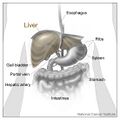 Liver and nearby organs
 -
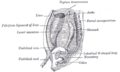 Gray's Anatomy illustration of the liver
 -
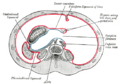 Gray's Anatomy illustration of the falciform ligament
 -
Falciform ligament


Medical Disclaimer: WikiMD is for informational purposes only and is not a substitute for professional medical advice. Content may be inaccurate or outdated and should not be used for diagnosis or treatment. Always consult your healthcare provider for medical decisions. Verify information with trusted sources such as CDC.gov and NIH.gov. By using this site, you agree that WikiMD is not liable for any outcomes related to its content. See full disclaimer.
Credits:Most images are courtesy of Wikimedia commons, and templates, categories Wikipedia, licensed under CC BY SA or similar.
Translate page: - East Asian
中文,
日本,
한국어,
South Asian
हिन्दी,
தமிழ்,
తెలుగు,
Urdu,
ಕನ್ನಡ,
Southeast Asian
Indonesian,
Vietnamese,
Thai,
မြန်မာဘာသာ,
বাংলা
European
español,
Deutsch,
français,
Greek,
português do Brasil,
polski,
română,
русский,
Nederlands,
norsk,
svenska,
suomi,
Italian
Middle Eastern & African
عربى,
Turkish,
Persian,
Hebrew,
Afrikaans,
isiZulu,
Kiswahili,
Other
Bulgarian,
Hungarian,
Czech,
Swedish,
മലയാളം,
मराठी,
ਪੰਜਾਬੀ,
ગુજરાતી,
Portuguese,
Ukrainian


