Fertilisation
Fertilisation is a process in sexual reproduction that involves the union of male (sperm) and female (ovum) gametes (each with a single, haploid set of chromosomes) to produce a diploid zygote.
Process[edit]
The process of fertilisation involves several stages:
- Contact: The sperm makes contact with the ovum's protective outer layer, the zona pellucida.
- Acrosomal reaction: The sperm's acrosome releases digestive enzymes to break down the zona pellucida.
- Sperm binding: Proteins on the sperm head bind to the zona pellucida.
- Cortical reaction: The ovum releases enzymes to harden the zona pellucida and prevent other sperm from binding.
- Fusion: The sperm and ovum plasma membranes fuse, allowing the sperm to enter the ovum.
- Activation: The ovum completes its second meiotic division, forming the mature ovum and second polar body.
- Nuclear fusion: The sperm and ovum nuclei fuse to form the diploid zygote.
Consequences[edit]
Fertilisation initiates the development of a new individual organism, starting with the formation of the zygote, which develops into an embryo and eventually a fully formed individual. It also determines the genetic makeup of the new individual, including its sex.
See also[edit]
References[edit]

This WikiMD article can only be edited by registered and verified editors. You can log in or register.
-
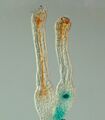
 Sperm approaching egg
 -
 Fertilisation process
 -
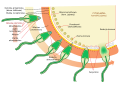 Diagram of acrosome reaction
 -
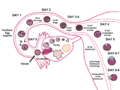 Human fertilization
 -
Fertilisation


Medical Disclaimer: WikiMD is for informational purposes only and is not a substitute for professional medical advice. Content may be inaccurate or outdated and should not be used for diagnosis or treatment. Always consult your healthcare provider for medical decisions. Verify information with trusted sources such as CDC.gov and NIH.gov. By using this site, you agree that WikiMD is not liable for any outcomes related to its content. See full disclaimer.
Credits:Most images are courtesy of Wikimedia commons, and templates, categories Wikipedia, licensed under CC BY SA or similar.
Translate page: - East Asian
中文,
日本,
한국어,
South Asian
हिन्दी,
தமிழ்,
తెలుగు,
Urdu,
ಕನ್ನಡ,
Southeast Asian
Indonesian,
Vietnamese,
Thai,
မြန်မာဘာသာ,
বাংলা
European
español,
Deutsch,
français,
Greek,
português do Brasil,
polski,
română,
русский,
Nederlands,
norsk,
svenska,
suomi,
Italian
Middle Eastern & African
عربى,
Turkish,
Persian,
Hebrew,
Afrikaans,
isiZulu,
Kiswahili,
Other
Bulgarian,
Hungarian,
Czech,
Swedish,
മലയാളം,
मराठी,
ਪੰਜਾਬੀ,
ગુજરાતી,
Portuguese,
Ukrainian


