Flagellum
Flagellum is a whip-like structure that allows a cell to move. They are found in all three domains of the cellular world: Bacteria, Archaea, and Eukarya.
Structure[edit]
In bacteria, the flagellum is a complex rotating structure driven by a molecular motor at the base. In eukaryotes, it is a complex bending structure driven by molecular motors that slide microtubules.
Function[edit]
Flagella are primarily used for cell movement. They are not fast enough to allow bacteria and sperm to swim against a current, but they can allow a cell to move in a particular direction in a liquid medium.
Types[edit]
There are three types of flagella: bacterial, archaeal, and eukaryotic.
Bacterial[edit]
The bacterial flagellum is made up of the protein flagellin. Its shape is a 20 nanometer-thick hollow tube. It is helical and has a sharp bend just outside the outer membrane; this "hook" allows the axis of the helix to point directly away from the cell.
Archaeal[edit]
Archaeal flagella are a different structure which has a similar function and overall appearance to bacterial flagella, but are not homologous.
Eukaryotic[edit]
Eukaryotic flagella are complex cellular projections that lash back and forth. Unlike bacterial flagella, they are composed of a bundle of nine fused pairs of microtubule doublets surrounding two central single microtubules.
See Also[edit]

This WikiMD article can only be edited by registered and verified editors. You can log in or register.
-
 Difference Between Prokaryote and Eukaryote Flagella
 -
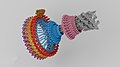 Flagellar Motor Assembly
 -
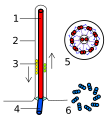 Eukarya Flagella
 -
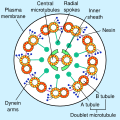 Eukaryotic Flagellum
 -
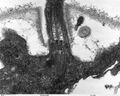 Chlamydomonas TEM 09
 -
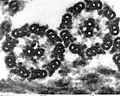 Chlamydomonas TEM 17
 -
 Flagellum Beating
 -
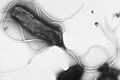 EMpylori
 -
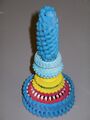 Physical Model of a Bacterial Flagellum


Medical Disclaimer: WikiMD is for informational purposes only and is not a substitute for professional medical advice. Content may be inaccurate or outdated and should not be used for diagnosis or treatment. Always consult your healthcare provider for medical decisions. Verify information with trusted sources such as CDC.gov and NIH.gov. By using this site, you agree that WikiMD is not liable for any outcomes related to its content. See full disclaimer.
Credits:Most images are courtesy of Wikimedia commons, and templates, categories Wikipedia, licensed under CC BY SA or similar.
Translate page: - East Asian
中文,
日本,
한국어,
South Asian
हिन्दी,
தமிழ்,
తెలుగు,
Urdu,
ಕನ್ನಡ,
Southeast Asian
Indonesian,
Vietnamese,
Thai,
မြန်မာဘာသာ,
বাংলা
European
español,
Deutsch,
français,
Greek,
português do Brasil,
polski,
română,
русский,
Nederlands,
norsk,
svenska,
suomi,
Italian
Middle Eastern & African
عربى,
Turkish,
Persian,
Hebrew,
Afrikaans,
isiZulu,
Kiswahili,
Other
Bulgarian,
Hungarian,
Czech,
Swedish,
മലയാളം,
मराठी,
ਪੰਜਾਬੀ,
ગુજરાતી,
Portuguese,
Ukrainian

