Head
The head is the part of an organism which usually includes the brain, eyes, ears, nose and mouth, each of which aid in various sensory functions such as sight, hearing, smell, and taste, respectively.Cite error: Invalid <ref> tag; refs with no name must have content Some very simple animals may not have a head, but many bilaterally symmetric forms do, regardless of actual complexity.
Anatomy[edit]
The human head consists of a brain, usually three sense organs, one bilateral, two eyes, and two ears, plus three collective sense organs, one mouth, one nose, and one tongue.
Brain[edit]
The brain is an organ that serves as the center of the nervous system in all vertebrate and most invertebrate animals. It is located in the head, usually close to the sensory organs for senses such as vision.
Eyes[edit]
The eye is a sensory organ that allows vision. Rod and cone cells in the retina allow conscious light perception and vision including color differentiation and the perception of depth.
Ears[edit]
The ear is the organ that detects sound. It not only receives sound, but also aids in balance and body position.
Nose[edit]
The nose is the organ that allows for the sense of smell. The cavity of the nose is lined with mucous membranes that have smell receptors connected to the olfactory nerve.
Mouth[edit]
The mouth is the first part of the alimentary canal that receives food and produces saliva. The mouth also contains the tongue and the teeth.
Function[edit]
The head houses the brain which controls the body. The head is also the sensory interface with the environment, collecting information from the senses of sight, smell, taste, touch, and hearing.
See also[edit]
References[edit]

This WikiMD article can only be edited by registered and verified editors. You can log in or register.
-
Portrait of a Meerkat
-
Beethoven death mask
-
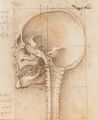 View of a Skull III
 -
Bartholin head transect
-
Nomada krugii, F, face, Dominican Republic
-
 Flag of Corsica
 -
 Leonardo da Vinci, Study on the proportions of head and eyes
 -
 Domenico Beccafumi - Tête de jeune homme
 -
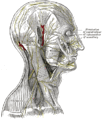 Head nerves
 -
Andrea Vaccaro, Tête de Saint-Jean Baptiste
-
 Statue de Saint Solange


Medical Disclaimer: WikiMD is for informational purposes only and is not a substitute for professional medical advice. Content may be inaccurate or outdated and should not be used for diagnosis or treatment. Always consult your healthcare provider for medical decisions. Verify information with trusted sources such as CDC.gov and NIH.gov. By using this site, you agree that WikiMD is not liable for any outcomes related to its content. See full disclaimer.
Credits:Most images are courtesy of Wikimedia commons, and templates, categories Wikipedia, licensed under CC BY SA or similar.
Translate page: - East Asian
中文,
日本,
한국어,
South Asian
हिन्दी,
தமிழ்,
తెలుగు,
Urdu,
ಕನ್ನಡ,
Southeast Asian
Indonesian,
Vietnamese,
Thai,
မြန်မာဘာသာ,
বাংলা
European
español,
Deutsch,
français,
Greek,
português do Brasil,
polski,
română,
русский,
Nederlands,
norsk,
svenska,
suomi,
Italian
Middle Eastern & African
عربى,
Turkish,
Persian,
Hebrew,
Afrikaans,
isiZulu,
Kiswahili,
Other
Bulgarian,
Hungarian,
Czech,
Swedish,
മലയാളം,
मराठी,
ਪੰਜਾਬੀ,
ગુજરાતી,
Portuguese,
Ukrainian


.jpg)
