Irregular bone
Irregular bones are bones in the human body that do not fall into any other category, due to their non-uniform shape. Precise function of these bones is generally determined by their shape, and they primarily consist of spongy bone, with a thin outer layer of compact bone.
Structure[edit]
Irregular bones are primarily made of spongy bone, also known as cancellous bone, which is characterized by a spongy, honeycomb-like structure. This type of bone is highly vascular and contains red bone marrow. The outer surface of irregular bones is composed of a thin layer of compact bone, also known as cortical bone, which is dense, strong, and durable.
Function[edit]
The shape of irregular bones often determines their specific function. They primarily serve to protect internal organs, provide support and stability, and aid in movement.
Examples[edit]
Examples of irregular bones include the vertebrae, sacrum, coccyx, temporal, sphenoid, and ethmoid bones in the skull, and the zygomatic, maxilla, and mandible bones in the face.
See also[edit]
References[edit]

This WikiMD article can only be edited by registered and verified editors. You can log in or register.
-
Irregular bone
-
Irregular bones - anterior view
-
Irregular bones - animation
-
Irregular bones in skull - lateral view
-
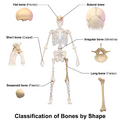 Classification of bones


Medical Disclaimer: WikiMD is for informational purposes only and is not a substitute for professional medical advice. Content may be inaccurate or outdated and should not be used for diagnosis or treatment. Always consult your healthcare provider for medical decisions. Verify information with trusted sources such as CDC.gov and NIH.gov. By using this site, you agree that WikiMD is not liable for any outcomes related to its content. See full disclaimer.
Credits:Most images are courtesy of Wikimedia commons, and templates, categories Wikipedia, licensed under CC BY SA or similar.
Translate page: - East Asian
中文,
日本,
한국어,
South Asian
हिन्दी,
தமிழ்,
తెలుగు,
Urdu,
ಕನ್ನಡ,
Southeast Asian
Indonesian,
Vietnamese,
Thai,
မြန်မာဘာသာ,
বাংলা
European
español,
Deutsch,
français,
Greek,
português do Brasil,
polski,
română,
русский,
Nederlands,
norsk,
svenska,
suomi,
Italian
Middle Eastern & African
عربى,
Turkish,
Persian,
Hebrew,
Afrikaans,
isiZulu,
Kiswahili,
Other
Bulgarian,
Hungarian,
Czech,
Swedish,
മലയാളം,
मराठी,
ਪੰਜਾਬੀ,
ગુજરાતી,
Portuguese,
Ukrainian


