Japanese rice
Japanese rice refers to a number of short-grain cultivars of Japonica rice including ordinary rice (uruchimai) and glutinous rice (mochigome).
Overview[edit]
Japanese rice is a staple part of the Japanese cuisine. It is used in a variety of dishes, including sushi, onigiri (rice balls), and donburi (rice bowls). The rice is known for its unique stickiness and texture, which is achieved through a high content of a specific type of starch called amylopectin.
Varieties[edit]
There are several varieties of Japanese rice, each with its own unique characteristics and uses.
Uruchimai[edit]
Uruchimai is the most common type of Japanese rice, and is used as an everyday staple by the Japanese people. It is a short-grain rice, and becomes sticky when cooked.
Mochigome[edit]
Mochigome is a type of glutinous rice used in Japan. Despite its name, it does not contain gluten, but rather a higher amount of starch. This rice is used for making mochi (rice cakes) and traditional sweets.
Cultivation[edit]
Japanese rice is cultivated in all parts of Japan, although the prefectures of Niigata, Akita, and Ibaraki are particularly well-known for their rice production. The rice is typically planted in the spring and harvested in the autumn.
Preparation[edit]
Japanese rice is typically rinsed before cooking to remove the bran layer and any remaining rice powder. It is then soaked in water for a period of time before being cooked. The rice is usually cooked in rice cookers, but can also be cooked in a pot on the stove.
Cultural significance[edit]
Rice is deeply ingrained in Japanese culture and traditions. It is not only a staple food, but also used in various festivals and ceremonies. For example, during the New Year's celebrations, it is common to make mochi, a type of rice cake, from mochigome.
See also[edit]
|
This article is part of the series |
|
Japanese cuisine |
|---|
|
Regional cuisines |
|
Ingredients |
|
Preparation and cooking |
|
Utensils |
|
Rituals and festivals |
|
|

-
Stages of rice milling
-
Rice field in Tawaramoto
-
Koshihikari and Calrose rice
-
Bowl of sushi by Hiroshige
-
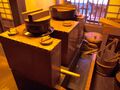 Traditional Edo period kamado
 -
Japanese rice in Wajima-nuri lacquerware


Medical Disclaimer: WikiMD is for informational purposes only and is not a substitute for professional medical advice. Content may be inaccurate or outdated and should not be used for diagnosis or treatment. Always consult your healthcare provider for medical decisions. Verify information with trusted sources such as CDC.gov and NIH.gov. By using this site, you agree that WikiMD is not liable for any outcomes related to its content. See full disclaimer.
Credits:Most images are courtesy of Wikimedia commons, and templates, categories Wikipedia, licensed under CC BY SA or similar.
Translate page: - East Asian
中文,
日本,
한국어,
South Asian
हिन्दी,
தமிழ்,
తెలుగు,
Urdu,
ಕನ್ನಡ,
Southeast Asian
Indonesian,
Vietnamese,
Thai,
မြန်မာဘာသာ,
বাংলা
European
español,
Deutsch,
français,
Greek,
português do Brasil,
polski,
română,
русский,
Nederlands,
norsk,
svenska,
suomi,
Italian
Middle Eastern & African
عربى,
Turkish,
Persian,
Hebrew,
Afrikaans,
isiZulu,
Kiswahili,
Other
Bulgarian,
Hungarian,
Czech,
Swedish,
മലയാളം,
मराठी,
ਪੰਜਾਬੀ,
ગુજરાતી,
Portuguese,
Ukrainian


