Jugular foramen
Jugular foramen is a large aperture in the base of the skull. It is located behind the carotid canal and is formed in front by the petrous portion of the temporal bone, and behind by the occipital bone; it is generally larger on the right than on the left side.
Etymology[edit]
The term "jugular" originates from the Latin word "jugulum" which means throat. The term "foramen" is derived from Latin and means "hole" or "opening".
Structure[edit]
The jugular foramen may be subdivided into three compartments, each with their own contents. The anterior compartment transmits the inferior petrosal sinus. The intermediate compartment transmits the glossopharyngeal nerve, vagus nerve, and accessory nerve. The posterior compartment transmits the sigmoid sinus (becoming the internal jugular vein) and some meningeal branches from the occipital artery and ascending pharyngeal artery.
Clinical significance[edit]
The jugular foramen has clinical significance due to the structures that pass through it. Lesions, such as glomus jugulare tumors, that expand into the foramen can cause symptoms related to the structures that pass through the foramen. These symptoms can include dysphagia, hoarseness, and loss of voice due to involvement of the glossopharyngeal and vagus nerves.
See also[edit]
References[edit]

This WikiMD article can only be edited by registered and verified editors. You can log in or register.
-
Jugular foramen
-
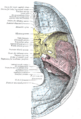 Jugular foramen
 -
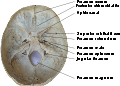 Jugular foramen


Medical Disclaimer: WikiMD is for informational purposes only and is not a substitute for professional medical advice. Content may be inaccurate or outdated and should not be used for diagnosis or treatment. Always consult your healthcare provider for medical decisions. Verify information with trusted sources such as CDC.gov and NIH.gov. By using this site, you agree that WikiMD is not liable for any outcomes related to its content. See full disclaimer.
Credits:Most images are courtesy of Wikimedia commons, and templates, categories Wikipedia, licensed under CC BY SA or similar.
Translate page: - East Asian
中文,
日本,
한국어,
South Asian
हिन्दी,
தமிழ்,
తెలుగు,
Urdu,
ಕನ್ನಡ,
Southeast Asian
Indonesian,
Vietnamese,
Thai,
မြန်မာဘာသာ,
বাংলা
European
español,
Deutsch,
français,
Greek,
português do Brasil,
polski,
română,
русский,
Nederlands,
norsk,
svenska,
suomi,
Italian
Middle Eastern & African
عربى,
Turkish,
Persian,
Hebrew,
Afrikaans,
isiZulu,
Kiswahili,
Other
Bulgarian,
Hungarian,
Czech,
Swedish,
മലയാളം,
मराठी,
ਪੰਜਾਬੀ,
ગુજરાતી,
Portuguese,
Ukrainian


