Kitsune
Japanese fox spirit
Kitsune or 狐 are foxes in Japanese folklore. The word "kitsune" is often translated as "fox" in English, and these creatures are a common subject of Japanese mythology and stories. Kitsune are believed to possess supernatural abilities that increase with their age and wisdom. According to folklore, all foxes have the ability to shape-shift into human form. While some folktales speak of kitsune employing this ability to trick others—as foxes in folklore often do—other stories portray them as faithful guardians, friends, lovers, and wives.
Origins and Mythology[edit]
Kitsune are closely associated with the Shinto deity Inari Ōkami, the god of rice, fertility, and prosperity. Inari's kitsune are white, a color of good omen. They act as his messengers and are often depicted in Shinto shrines dedicated to Inari. This role has reinforced the fox's supernatural significance.
Types of Kitsune[edit]
Kitsune are often divided into two main categories:
- Zenko (善狐, literally "good foxes") are benevolent, celestial foxes associated with Inari.
- Yako (野狐, literally "field foxes") are mischievous or even malicious foxes.
Abilities[edit]
Kitsune are known for their ability to shape-shift into human form, a trait they acquire when they reach a certain age—usually 100 years. They can transform into beautiful women, young girls, or elderly men. Kitsune can also possess people, a phenomenon known as kitsunetsuki.
Cultural Significance[edit]
Kitsune have a significant presence in Japanese culture, appearing in various forms of literature, theater, and art. They are also a popular subject in anime and manga. The dual nature of kitsune, as both tricksters and protectors, reflects the complex relationship humans have with the natural world.
Gallery[edit]
-
Gyokuzan Kitsunetsuki
-
 Hiroshige%2C New Year's Eve foxfires at the changing tree%2C Oji%2C 1857
 -
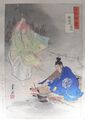 Blacksmith Munechika, helped by a fox spirit, forging the blade Ko-Gitsune Maru, by Ogata Gekkō
 -
Obake Karuta 3-01


Related Pages[edit]
| Japanese mythology | ||||||||||
|---|---|---|---|---|---|---|---|---|---|---|
|
 | This folklore-related article is a stub. You can help WikiMD by expanding the page. |

Medical Disclaimer: WikiMD is for informational purposes only and is not a substitute for professional medical advice. Content may be inaccurate or outdated and should not be used for diagnosis or treatment. Always consult your healthcare provider for medical decisions. Verify information with trusted sources such as CDC.gov and NIH.gov. By using this site, you agree that WikiMD is not liable for any outcomes related to its content. See full disclaimer.
Credits:Most images are courtesy of Wikimedia commons, and templates, categories Wikipedia, licensed under CC BY SA or similar.
Translate page: - East Asian
中文,
日本,
한국어,
South Asian
हिन्दी,
தமிழ்,
తెలుగు,
Urdu,
ಕನ್ನಡ,
Southeast Asian
Indonesian,
Vietnamese,
Thai,
မြန်မာဘာသာ,
বাংলা
European
español,
Deutsch,
français,
Greek,
português do Brasil,
polski,
română,
русский,
Nederlands,
norsk,
svenska,
suomi,
Italian
Middle Eastern & African
عربى,
Turkish,
Persian,
Hebrew,
Afrikaans,
isiZulu,
Kiswahili,
Other
Bulgarian,
Hungarian,
Czech,
Swedish,
മലയാളം,
मराठी,
ਪੰਜਾਬੀ,
ગુજરાતી,
Portuguese,
Ukrainian


