Kupffer cell
Kupffer cells are specialized macrophages located in the liver, named after Karl Wilhelm von Kupffer who first identified them. They form part of the mononuclear phagocyte system, a network of cells that play a crucial role in the body's immune response.
Function[edit]
Kupffer cells are primarily responsible for the removal of old, damaged or abnormal red blood cells from the bloodstream. They also play a role in the immune response, producing cytokines and other signaling molecules that help to coordinate the body's response to infection and inflammation.
Structure[edit]
Kupffer cells are large, irregularly shaped cells with numerous projections that extend into the sinusoidal lumen of the liver. They are located in the sinusoidal endothelium, the thin layer of cells that lines the liver's blood vessels.
Role in Disease[edit]
Kupffer cells can contribute to the development of several liver diseases, including cirrhosis, hepatitis, and liver cancer. They can also play a role in systemic diseases such as sepsis and malaria, as these conditions can significantly affect the function of the liver.
Research[edit]
Research into Kupffer cells is ongoing, with scientists seeking to better understand their role in health and disease. This research could potentially lead to new treatments for a range of liver and systemic diseases.
See Also[edit]
 | This medical article is a stub. You can help WikiMD by expanding the page. |
-
Interaction between Kupffer cells, Stellate cells, and endothelial cells
-
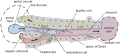 Hepatic structure


Medical Disclaimer: WikiMD is for informational purposes only and is not a substitute for professional medical advice. Content may be inaccurate or outdated and should not be used for diagnosis or treatment. Always consult your healthcare provider for medical decisions. Verify information with trusted sources such as CDC.gov and NIH.gov. By using this site, you agree that WikiMD is not liable for any outcomes related to its content. See full disclaimer.
Credits:Most images are courtesy of Wikimedia commons, and templates, categories Wikipedia, licensed under CC BY SA or similar.
Translate page: - East Asian
中文,
日本,
한국어,
South Asian
हिन्दी,
தமிழ்,
తెలుగు,
Urdu,
ಕನ್ನಡ,
Southeast Asian
Indonesian,
Vietnamese,
Thai,
မြန်မာဘာသာ,
বাংলা
European
español,
Deutsch,
français,
Greek,
português do Brasil,
polski,
română,
русский,
Nederlands,
norsk,
svenska,
suomi,
Italian
Middle Eastern & African
عربى,
Turkish,
Persian,
Hebrew,
Afrikaans,
isiZulu,
Kiswahili,
Other
Bulgarian,
Hungarian,
Czech,
Swedish,
മലയാളം,
मराठी,
ਪੰਜਾਬੀ,
ગુજરાતી,
Portuguese,
Ukrainian


