Lac operon
Lac operon is a genetic regulatory system found in Escherichia coli (E. coli) and some other bacteria. It consists of a series of genes which are responsible for the metabolism of lactose in these organisms. The lac operon was first described by François Jacob and Jacques Monod in 1961, who were awarded the Nobel Prize in Physiology or Medicine for their work in 1965.
Structure[edit]
The lac operon consists of three structural genes, and a promoter, a terminator, regulator, and an operator. The three structural genes are: lacZ, lacY, and lacA.
- lacZ codes for beta-galactosidase, an enzyme that cleaves lactose into glucose and galactose.
- lacY codes for permease, a protein that aids in the transport of lactose into the cell.
- lacA codes for transacetylase, an enzyme that transfers an acetyl group from acetyl-CoA to beta-galactosides.
Regulation[edit]
The lac operon is regulated by several factors including the availability of glucose and lactose. It is an example of a negative control system because it is regulated by a repressor, the lacI gene product, which inhibits transcription. When lactose is present, it is converted into allolactose, which inhibits the repressor, allowing transcription to occur.
Induction and Repression[edit]
In the absence of lactose, the lac repressor binds to the operator region of the operon and prevents transcription of the downstream genes. When lactose is present, it binds to the repressor, causing a conformational change that makes it unable to bind to the operator. This is known as induction.
In the presence of glucose, the bacterium will suppress the lac operon to use the more energetically favorable glucose. This is known as catabolite repression.
Significance[edit]
The discovery of the lac operon has been fundamental to our understanding of gene regulation. It was the first genetic regulatory system to be understood in detail and has served as a model for the study of other genetic regulatory systems.
See also[edit]

-
Lac operon
-
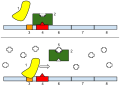 Lac operon
 -
Lactose etc
-
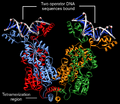 Annotated theoretical model of bound tetrameric Lac repressor
 -
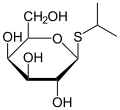 IPTG
IPTG -
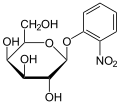 ONPG
ONPG -
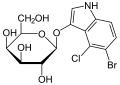 X-Gal
X-Gal -
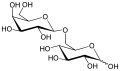 Allolactose
 -
Monod's and Jacob's growth experiment
-
Lac complementation
-
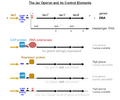 Lac operon


Medical Disclaimer: WikiMD is for informational purposes only and is not a substitute for professional medical advice. Content may be inaccurate or outdated and should not be used for diagnosis or treatment. Always consult your healthcare provider for medical decisions. Verify information with trusted sources such as CDC.gov and NIH.gov. By using this site, you agree that WikiMD is not liable for any outcomes related to its content. See full disclaimer.
Credits:Most images are courtesy of Wikimedia commons, and templates, categories Wikipedia, licensed under CC BY SA or similar.
Translate page: - East Asian
中文,
日本,
한국어,
South Asian
हिन्दी,
தமிழ்,
తెలుగు,
Urdu,
ಕನ್ನಡ,
Southeast Asian
Indonesian,
Vietnamese,
Thai,
မြန်မာဘာသာ,
বাংলা
European
español,
Deutsch,
français,
Greek,
português do Brasil,
polski,
română,
русский,
Nederlands,
norsk,
svenska,
suomi,
Italian
Middle Eastern & African
عربى,
Turkish,
Persian,
Hebrew,
Afrikaans,
isiZulu,
Kiswahili,
Other
Bulgarian,
Hungarian,
Czech,
Swedish,
മലയാളം,
मराठी,
ਪੰਜਾਬੀ,
ગુજરાતી,
Portuguese,
Ukrainian


