Linear regression
Linear regression is a statistical analysis technique used to understand the relationship between two variables. It is a fundamental tool in statistics, machine learning, and data science.
Overview[edit]
Linear regression models the relationship between two variables by fitting a linear equation to observed data. The steps to perform linear regression are:
- Collect and prepare data
- Choose the type of regression to use
- Create the model
- Check the model fit
- Make predictions
Types of Linear Regression[edit]
There are two types of linear regression:
- Simple linear regression: One independent variable and one dependent variable
- Multiple linear regression: More than one independent variable and one dependent variable
Assumptions of Linear Regression[edit]
Linear regression makes several assumptions:
- Linearity: The relationship between the independent and dependent variable is linear.
- Independence: The observations are independent of each other.
- Homoscedasticity: The variance of the errors is constant across all levels of the independent variables.
- Normality: The errors of the prediction will follow a normal distribution.
Applications of Linear Regression[edit]
Linear regression is used in various fields including:
- Economics: To understand the economic factors affecting business
- Finance: To predict stock prices
- Healthcare: To predict disease trends
- Machine Learning: As a prediction algorithm
See Also[edit]

This WikiMD article can only be edited by registered and verified editors. You can log in or register.
-
Linear least squares example
-
Polynomial regression example
-
Heteroscedasticity in linear regression
-
Independence of errors assumption for linear regressions
-
Anscombe's quartet example
-
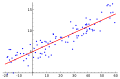 Linear regression
 -
Galton's correlation diagram 1875
-
Thiel-Sen estimator


Medical Disclaimer: WikiMD is for informational purposes only and is not a substitute for professional medical advice. Content may be inaccurate or outdated and should not be used for diagnosis or treatment. Always consult your healthcare provider for medical decisions. Verify information with trusted sources such as CDC.gov and NIH.gov. By using this site, you agree that WikiMD is not liable for any outcomes related to its content. See full disclaimer.
Credits:Most images are courtesy of Wikimedia commons, and templates, categories Wikipedia, licensed under CC BY SA or similar.
Translate page: - East Asian
中文,
日本,
한국어,
South Asian
हिन्दी,
தமிழ்,
తెలుగు,
Urdu,
ಕನ್ನಡ,
Southeast Asian
Indonesian,
Vietnamese,
Thai,
မြန်မာဘာသာ,
বাংলা
European
español,
Deutsch,
français,
Greek,
português do Brasil,
polski,
română,
русский,
Nederlands,
norsk,
svenska,
suomi,
Italian
Middle Eastern & African
عربى,
Turkish,
Persian,
Hebrew,
Afrikaans,
isiZulu,
Kiswahili,
Other
Bulgarian,
Hungarian,
Czech,
Swedish,
മലയാളം,
मराठी,
ਪੰਜਾਬੀ,
ગુજરાતી,
Portuguese,
Ukrainian


