Lunate bone
The Lunate bone is one of the eight carpal bones that are found in the human hand. It is named for its crescent shape, with "lunate" derived from the Latin word "luna," meaning moon. The lunate bone is located in the proximal row of the carpal bones, between the scaphoid bone and the triquetral bone.
Structure[edit]
The lunate bone is a small, crescent-shaped bone that is situated in the center of the wrist. It has a convex upper surface that articulates with the radius bone in the forearm, and a concave lower surface that articulates with the capitate and hamate bones in the hand. The lunate bone is unique among the carpal bones in that it has no direct muscular attachments.
Function[edit]
The primary function of the lunate bone is to facilitate movement of the wrist. It acts as a pivot point for the wrist, allowing for flexion, extension, adduction, and abduction of the hand. The lunate bone also plays a crucial role in transmitting forces from the hand to the forearm.
Clinical significance[edit]
Injuries to the lunate bone, such as fractures or dislocations, can lead to a condition known as Kienbock's disease, which is characterized by the death of bone tissue due to a lack of blood supply. This condition can cause pain, swelling, and limited movement in the wrist.
See also[edit]
References[edit]

-
Lunate bone
-
Lunate bone
-
Lunate bone
-
Lunate bone
-
Lunate bone
-
Lunate bone
-
Lunate bone
-
Lunate bone
-
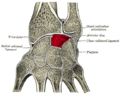 Lunate bone
 -
Lunate bone
-
Lunate bone
-
 Lunate bone


Medical Disclaimer: WikiMD is for informational purposes only and is not a substitute for professional medical advice. Content may be inaccurate or outdated and should not be used for diagnosis or treatment. Always consult your healthcare provider for medical decisions. Verify information with trusted sources such as CDC.gov and NIH.gov. By using this site, you agree that WikiMD is not liable for any outcomes related to its content. See full disclaimer.
Credits:Most images are courtesy of Wikimedia commons, and templates, categories Wikipedia, licensed under CC BY SA or similar.
Translate page: - East Asian
中文,
日本,
한국어,
South Asian
हिन्दी,
தமிழ்,
తెలుగు,
Urdu,
ಕನ್ನಡ,
Southeast Asian
Indonesian,
Vietnamese,
Thai,
မြန်မာဘာသာ,
বাংলা
European
español,
Deutsch,
français,
Greek,
português do Brasil,
polski,
română,
русский,
Nederlands,
norsk,
svenska,
suomi,
Italian
Middle Eastern & African
عربى,
Turkish,
Persian,
Hebrew,
Afrikaans,
isiZulu,
Kiswahili,
Other
Bulgarian,
Hungarian,
Czech,
Swedish,
മലയാളം,
मराठी,
ਪੰਜਾਬੀ,
ગુજરાતી,
Portuguese,
Ukrainian


_01_palmar_view.png)


_-_animation01.gif)
_-_animation02.gif)


