MacConkey agar
MacConkey Agar is a selective and differential culture medium for bacteria. It is designed to selectively isolate Gram-negative and enteric (normally found in the intestinal tract) bacilli and differentiate them based on lactose fermentation.
Composition[edit]
MacConkey Agar contains lactose, bile salts, neutral red, crystal violet, and agar. The bile salts and crystal violet inhibit the growth of Gram-positive organisms which makes MacConkey Agar selective. Neutral red is a pH indicator that turns red at a pH below 6.8 and is colorless at any pH greater than 6.8. Lactose provides a source of fermentable carbohydrate, allowing for differentiation.
Uses[edit]
MacConkey Agar is used for the isolation of Gram-negative enteric bacteria. It is used in the differentiation of lactose fermenting from lactose non-fermenting gram-negative bacteria. It is used in the detection and/or verification of E.coli in water, food, and dairy products.
Interpretation[edit]
On MacConkey Agar, colonies of lactose fermenting bacteria are brick-red and may be surrounded by a zone of precipitated bile. The red color is due to production of acid from lactose, absorption of neutral red and a subsequent color change of the pH indicator from colorless to red. Non-lactose fermenting bacteria form transparent, colorless colonies.
History[edit]
MacConkey Agar was developed in 20th century by Alfred Theodore MacConkey, an English bacteriologist. It was the first formulated solid differential media.
See also[edit]

This WikiMD article can only be edited by registered and verified editors. You can log in or register.
-
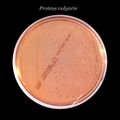 Proteus on MacConkey agar
 -
 Lactose fermentation
 -
MacConkey agar with lactose fermenting and non-lactose fermenting colonies


Medical Disclaimer: WikiMD is for informational purposes only and is not a substitute for professional medical advice. Content may be inaccurate or outdated and should not be used for diagnosis or treatment. Always consult your healthcare provider for medical decisions. Verify information with trusted sources such as CDC.gov and NIH.gov. By using this site, you agree that WikiMD is not liable for any outcomes related to its content. See full disclaimer.
Credits:Most images are courtesy of Wikimedia commons, and templates, categories Wikipedia, licensed under CC BY SA or similar.
Translate page: - East Asian
中文,
日本,
한국어,
South Asian
हिन्दी,
தமிழ்,
తెలుగు,
Urdu,
ಕನ್ನಡ,
Southeast Asian
Indonesian,
Vietnamese,
Thai,
မြန်မာဘာသာ,
বাংলা
European
español,
Deutsch,
français,
Greek,
português do Brasil,
polski,
română,
русский,
Nederlands,
norsk,
svenska,
suomi,
Italian
Middle Eastern & African
عربى,
Turkish,
Persian,
Hebrew,
Afrikaans,
isiZulu,
Kiswahili,
Other
Bulgarian,
Hungarian,
Czech,
Swedish,
മലയാളം,
मराठी,
ਪੰਜਾਬੀ,
ગુજરાતી,
Portuguese,
Ukrainian


