Marrubium vulgare
Marrubium vulgare, commonly known as horehound, is a flowering plant in the Lamiaceae family. It is native to Europe, northern Africa, and southwestern and central Asia. It is also naturalized in many places, including North and South America.
Description[edit]
Marrubium vulgare is a perennial plant that can grow up to 45 cm high. The leaves are 2-5 cm long, oval, hairy, and have a bitter taste. The flowers are small, white, and grow in dense clusters.
Cultivation and uses[edit]
Marrubium vulgare is often grown in herb gardens for its medicinal properties. It is also used as a flavoring in foods and beverages. The plant is considered a weed in some areas.
Medicinal uses[edit]
The leaves and flowering tops of Marrubium vulgare are used to make medicine. Horehound is used for digestion problems including loss of appetite, indigestion, bloating, gas, diarrhea, constipation, and liver and gallbladder complaints. It is also used for lung and breathing problems including cough, whooping cough, asthma, tuberculosis, bronchitis, and swollen breathing passages.
Other uses[edit]
In addition to its medicinal uses, Marrubium vulgare is also used as a flavoring in foods and beverages. It is a key ingredient in horehound candy, a type of hard candy that is popular in some countries.
See also[edit]
References[edit]
| Medicinal plants | ||||||||
|---|---|---|---|---|---|---|---|---|
This medicinal plants related article is a stub.
|
 | This Lamiaceae article is a stub. You can help WikiMD by expanding the page. |
-
 Illustration of Marrubium vulgare from Köhler's Medicinal Plants
 -
 Historical text mentioning Marrubium vulgare
 -
 Horehound candy drops made from Marrubium vulgare
 -
 Marrubium vulgare plant
 -
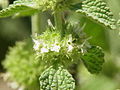 Marrubium vulgare in bloom
 -
 Insect on Marrubium vulgare
 -
 Marrubium vulgare growing in Mexico


Medical Disclaimer: WikiMD is for informational purposes only and is not a substitute for professional medical advice. Content may be inaccurate or outdated and should not be used for diagnosis or treatment. Always consult your healthcare provider for medical decisions. Verify information with trusted sources such as CDC.gov and NIH.gov. By using this site, you agree that WikiMD is not liable for any outcomes related to its content. See full disclaimer.
Credits:Most images are courtesy of Wikimedia commons, and templates, categories Wikipedia, licensed under CC BY SA or similar.
Translate page: - East Asian
中文,
日本,
한국어,
South Asian
हिन्दी,
தமிழ்,
తెలుగు,
Urdu,
ಕನ್ನಡ,
Southeast Asian
Indonesian,
Vietnamese,
Thai,
မြန်မာဘာသာ,
বাংলা
European
español,
Deutsch,
français,
Greek,
português do Brasil,
polski,
română,
русский,
Nederlands,
norsk,
svenska,
suomi,
Italian
Middle Eastern & African
عربى,
Turkish,
Persian,
Hebrew,
Afrikaans,
isiZulu,
Kiswahili,
Other
Bulgarian,
Hungarian,
Czech,
Swedish,
മലയാളം,
मराठी,
ਪੰਜਾਬੀ,
ગુજરાતી,
Portuguese,
Ukrainian

