Maxillary process of inferior nasal concha
[[File: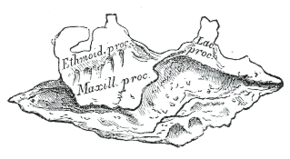 |frameless|alt=]]

| Details | |
|---|---|
| Synonyms | |
| Pronunciation | |
| Carnegie stage | |
| Days | |
| Precursor | |
| Gives rise to | |
| Part of | |
The maxillary process of the inferior nasal concha is a bony projection that extends from the inferior nasal concha, which is one of the three pairs of nasal conchae in the human nasal cavity. The inferior nasal concha is a separate bone, unlike the superior and middle conchae, which are parts of the ethmoid bone.
Anatomy[edit]
The maxillary process of the inferior nasal concha is located in the lateral wall of the nasal cavity. It articulates with the maxilla, specifically with the conchal crest of the maxilla. This articulation helps to form the lateral wall of the nasal cavity and contributes to the structure of the nasal passages.
The inferior nasal concha itself is a thin, curved bone that projects horizontally along the lateral wall of the nasal cavity. It serves to increase the surface area of the nasal cavity, aiding in the warming and humidification of inhaled air.
Function[edit]
The primary function of the maxillary process of the inferior nasal concha is to provide structural support to the nasal cavity. By articulating with the maxilla, it helps to stabilize the position of the inferior nasal concha, ensuring that it can effectively perform its role in air filtration and conditioning.
Clinical significance[edit]
The maxillary process of the inferior nasal concha can be involved in various nasal conditions. For instance, hypertrophy of the inferior nasal concha can lead to nasal obstruction, which may require surgical intervention. Understanding the anatomy of the maxillary process is crucial for surgeons performing procedures such as turbinate reduction or septoplasty.
Also see[edit]


Medical Disclaimer: WikiMD is for informational purposes only and is not a substitute for professional medical advice. Content may be inaccurate or outdated and should not be used for diagnosis or treatment. Always consult your healthcare provider for medical decisions. Verify information with trusted sources such as CDC.gov and NIH.gov. By using this site, you agree that WikiMD is not liable for any outcomes related to its content. See full disclaimer.
Credits:Most images are courtesy of Wikimedia commons, and templates, categories Wikipedia, licensed under CC BY SA or similar.
Translate page: - East Asian
中文,
日本,
한국어,
South Asian
हिन्दी,
தமிழ்,
తెలుగు,
Urdu,
ಕನ್ನಡ,
Southeast Asian
Indonesian,
Vietnamese,
Thai,
မြန်မာဘာသာ,
বাংলা
European
español,
Deutsch,
français,
Greek,
português do Brasil,
polski,
română,
русский,
Nederlands,
norsk,
svenska,
suomi,
Italian
Middle Eastern & African
عربى,
Turkish,
Persian,
Hebrew,
Afrikaans,
isiZulu,
Kiswahili,
Other
Bulgarian,
Hungarian,
Czech,
Swedish,
മലയാളം,
मराठी,
ਪੰਜਾਬੀ,
ગુજરાતી,
Portuguese,
Ukrainian

