Memory B cell
Memory B cells are a B cell subtype that are formed within germinal centers following primary infection.
Function[edit]
Memory B cells can survive for decades and repeatedly generate an antibody response to the antigen that triggered their production. They are responsible for the long-term immunity that results after infection or vaccination.
Formation[edit]
Memory B cells are formed from activated naive B cells that have encountered their specific antigen during a primary immune response. These cells proliferate and differentiate into plasma cells and memory B cells.
Activation[edit]
Upon re-exposure to their cognate antigen, memory B cells can differentiate into plasma cells that produce high-affinity antibodies or they can undergo a secondary germinal center reaction.
Types[edit]
There are two types of memory B cells: the BCR-independent memory B cells and the BCR-dependent memory B cells. The BCR-independent memory B cells are activated by T cells, while the BCR-dependent memory B cells are activated by the antigen itself.
Clinical significance[edit]
Memory B cells play a crucial role in vaccine-induced immunity. Understanding the mechanisms that regulate their formation and function could lead to the development of more effective vaccines.
 | This immunology article is a stub. You can help WikiMD by expanding the page. |
-
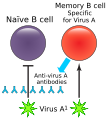 Memory B cell


Medical Disclaimer: WikiMD is for informational purposes only and is not a substitute for professional medical advice. Content may be inaccurate or outdated and should not be used for diagnosis or treatment. Always consult your healthcare provider for medical decisions. Verify information with trusted sources such as CDC.gov and NIH.gov. By using this site, you agree that WikiMD is not liable for any outcomes related to its content. See full disclaimer.
Credits:Most images are courtesy of Wikimedia commons, and templates, categories Wikipedia, licensed under CC BY SA or similar.
Translate page: - East Asian
中文,
日本,
한국어,
South Asian
हिन्दी,
தமிழ்,
తెలుగు,
Urdu,
ಕನ್ನಡ,
Southeast Asian
Indonesian,
Vietnamese,
Thai,
မြန်မာဘာသာ,
বাংলা
European
español,
Deutsch,
français,
Greek,
português do Brasil,
polski,
română,
русский,
Nederlands,
norsk,
svenska,
suomi,
Italian
Middle Eastern & African
عربى,
Turkish,
Persian,
Hebrew,
Afrikaans,
isiZulu,
Kiswahili,
Other
Bulgarian,
Hungarian,
Czech,
Swedish,
മലയാളം,
मराठी,
ਪੰਜਾਬੀ,
ગુજરાતી,
Portuguese,
Ukrainian

