Superior mesenteric lymph nodes
Superior Mesenteric Lymph Nodes are a group of lymph nodes located in the abdomen, specifically around the superior mesenteric artery. They play a crucial role in the immune system, helping to filter harmful substances and fight infections.
Anatomy[edit]
The superior mesenteric lymph nodes are located in the mesentery, a fold of the peritoneum that attaches the small intestine to the posterior wall of the abdomen. They are arranged around the superior mesenteric artery, which supplies blood to a large portion of the small intestine and part of the large intestine.
Function[edit]
Like all lymph nodes, the superior mesenteric lymph nodes are part of the body's immune system. They filter lymph, a fluid that contains white blood cells, for harmful substances such as bacteria and viruses. When these substances are detected, the lymph nodes produce more white blood cells to fight off the infection.
Clinical Significance[edit]
Enlargement of the superior mesenteric lymph nodes, known as lymphadenopathy, can be a sign of infection or disease in the intestines. This can be caused by a variety of conditions, including appendicitis, Crohn's disease, and cancer. In some cases, the lymph nodes may need to be biopsied to determine the cause of the enlargement.
See Also[edit]
References[edit]

Superior mesenteric lymph nodes[edit]
-
Superior mesenteric lymph nodes
-
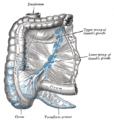 Lymphatic system of the abdomen
 -
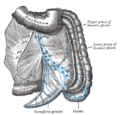 Lymphatic system of the abdomen, posterior view


Medical Disclaimer: WikiMD is for informational purposes only and is not a substitute for professional medical advice. Content may be inaccurate or outdated and should not be used for diagnosis or treatment. Always consult your healthcare provider for medical decisions. Verify information with trusted sources such as CDC.gov and NIH.gov. By using this site, you agree that WikiMD is not liable for any outcomes related to its content. See full disclaimer.
Credits:Most images are courtesy of Wikimedia commons, and templates, categories Wikipedia, licensed under CC BY SA or similar.
Translate page: - East Asian
中文,
日本,
한국어,
South Asian
हिन्दी,
தமிழ்,
తెలుగు,
Urdu,
ಕನ್ನಡ,
Southeast Asian
Indonesian,
Vietnamese,
Thai,
မြန်မာဘာသာ,
বাংলা
European
español,
Deutsch,
français,
Greek,
português do Brasil,
polski,
română,
русский,
Nederlands,
norsk,
svenska,
suomi,
Italian
Middle Eastern & African
عربى,
Turkish,
Persian,
Hebrew,
Afrikaans,
isiZulu,
Kiswahili,
Other
Bulgarian,
Hungarian,
Czech,
Swedish,
മലയാളം,
मराठी,
ਪੰਜਾਬੀ,
ગુજરાતી,
Portuguese,
Ukrainian


