Glia
Glia or glial cells are non-neuronal cells in the central nervous system and the peripheral nervous system. They maintain homeostasis, form myelin, and provide support and protection for neurons. In the central nervous system, glial cells include oligodendrocytes, astrocytes, ependymal cells, and microglia, and in the peripheral nervous system, glial cells include Schwann cells and satellite cells.
Function[edit]
Glia have four main functions:
- To surround neurons and hold them in place,
- To supply nutrients and oxygen to neurons,
- To insulate one neuron from another,
- To destroy pathogens and remove dead neurons.
Types of Glial Cells[edit]
Central Nervous System[edit]
- Oligodendrocytes - These cells produce the myelin sheath, a fatty layer that insulates nerve fibers in the central nervous system.
- Astrocytes - These are star-shaped cells that provide physical and nutritional support for neurons.
- Ependymal Cells - These cells line the ventricles of the brain and the central canal of the spinal cord.
- Microglia - These are the immune cells of the central nervous system.
Peripheral Nervous System[edit]
- Schwann Cells - These cells produce the myelin sheath in the peripheral nervous system.
- Satellite Cells - These cells surround the neuron cell bodies in the ganglia of the peripheral nervous system.
Diseases Related to Glia[edit]
Glia are involved in a number of neurological disorders, including multiple sclerosis, Alzheimer's disease, Parkinson's disease, and Amyotrophic lateral sclerosis.
See Also[edit]

This WikiMD article can only be edited by registered and verified editors. You can log in or register.
-
 Glial Cell Types
 -
Neuroglia
-
Glia
-
 Glia
Glia -
Types of Neuroglia
-
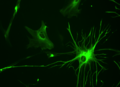 Human Astrocyte
 -
 Anaplastic Astrocytoma

.jpg)


Medical Disclaimer: WikiMD is for informational purposes only and is not a substitute for professional medical advice. Content may be inaccurate or outdated and should not be used for diagnosis or treatment. Always consult your healthcare provider for medical decisions. Verify information with trusted sources such as CDC.gov and NIH.gov. By using this site, you agree that WikiMD is not liable for any outcomes related to its content. See full disclaimer.
Credits:Most images are courtesy of Wikimedia commons, and templates, categories Wikipedia, licensed under CC BY SA or similar.
Translate page: - East Asian
中文,
日本,
한국어,
South Asian
हिन्दी,
தமிழ்,
తెలుగు,
Urdu,
ಕನ್ನಡ,
Southeast Asian
Indonesian,
Vietnamese,
Thai,
မြန်မာဘာသာ,
বাংলা
European
español,
Deutsch,
français,
Greek,
português do Brasil,
polski,
română,
русский,
Nederlands,
norsk,
svenska,
suomi,
Italian
Middle Eastern & African
عربى,
Turkish,
Persian,
Hebrew,
Afrikaans,
isiZulu,
Kiswahili,
Other
Bulgarian,
Hungarian,
Czech,
Swedish,
മലയാളം,
मराठी,
ਪੰਜਾਬੀ,
ગુજરાતી,
Portuguese,
Ukrainian


