Osteotomy
Osteotomy is a surgical procedure that involves the cutting and reshaping of bone. It is often used to correct deformities and improve alignment in conditions such as osteoarthritis and congenital hip dysplasia.
History[edit]
The first recorded osteotomy was performed by Bernhard Heine, a German orthopedic surgeon, in 1830. Heine used a chisel and mallet to perform the procedure, which was revolutionary at the time.
Types of Osteotomy[edit]
There are several types of osteotomy, including:
- High tibial osteotomy (HTO): This procedure is used to treat knee osteoarthritis by shifting the weight-bearing line to the healthier side of the knee.
- Distal femoral osteotomy (DFO): This procedure is used to correct deformities of the lower femur.
- Pelvic osteotomy: This procedure is used to correct hip dysplasia in children.
- Mandibular osteotomy: This procedure is used to correct deformities of the jaw.
Procedure[edit]
The procedure for an osteotomy varies depending on the type of osteotomy being performed and the specific patient's condition. However, the general steps include:
- The surgeon makes an incision over the area where the bone will be cut.
- The bone is cut using a special saw or chisel.
- The bone is reshaped and realigned.
- The bone is held in place with screws, plates, or rods until it heals.
Risks and Complications[edit]
As with any surgical procedure, there are risks associated with osteotomy. These can include:
- Infection
- Blood clots
- Nerve damage
- Nonunion (the bone does not heal properly)
- Malunion (the bone heals in the wrong position)
See Also[edit]

This WikiMD article can only be edited by registered and verified editors. You can log in or register.
Osteotomy[edit]
-
Osteotomy
-
X-ray of the hip after open reduction, capsulorrhaphy, and Dega and Chiari surgery
-
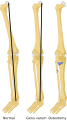 Osteotomy of the tibia


Medical Disclaimer: WikiMD is for informational purposes only and is not a substitute for professional medical advice. Content may be inaccurate or outdated and should not be used for diagnosis or treatment. Always consult your healthcare provider for medical decisions. Verify information with trusted sources such as CDC.gov and NIH.gov. By using this site, you agree that WikiMD is not liable for any outcomes related to its content. See full disclaimer.
Credits:Most images are courtesy of Wikimedia commons, and templates, categories Wikipedia, licensed under CC BY SA or similar.
Translate page: - East Asian
中文,
日本,
한국어,
South Asian
हिन्दी,
தமிழ்,
తెలుగు,
Urdu,
ಕನ್ನಡ,
Southeast Asian
Indonesian,
Vietnamese,
Thai,
မြန်မာဘာသာ,
বাংলা
European
español,
Deutsch,
français,
Greek,
português do Brasil,
polski,
română,
русский,
Nederlands,
norsk,
svenska,
suomi,
Italian
Middle Eastern & African
عربى,
Turkish,
Persian,
Hebrew,
Afrikaans,
isiZulu,
Kiswahili,
Other
Bulgarian,
Hungarian,
Czech,
Swedish,
മലയാളം,
मराठी,
ਪੰਜਾਬੀ,
ગુજરાતી,
Portuguese,
Ukrainian


_open_reduction,_capsulorrhaphy_and_Dega_and_(b)_Chiari_surgery.jpg)