Paramecium
Paramecium is a genus of unicellular ciliated protozoan and Bacterium under the phylum Ciliophora. They are common in freshwater, brackish, and marine environments and are often very abundant in stagnant basins and ponds.
Overview[edit]
Paramecium is a slipper-shaped or oblong organism that is covered in cilia, which are short hair-like structures. The cilia are used in locomotion and feeding. Paramecium is a well-known genus of unicellular organism, commonly studied as a representative of the ciliate group, and has been instrumental in some of the key findings in biology. It is known for its distinctive slipper-like shape and its method of propulsion via the use of cilia.
Anatomy[edit]
Paramecium has a complex structure. It has a definite shape and is covered with a flexible, thin and firm membrane known as the pellicle. The pellicle is covered with rows of cilia. The cilia beat in coordinated waves, allowing the Paramecium to move in water.
Reproduction[edit]
Paramecium reproduces asexually, by binary fission. During this process, the macronucleus splits by a type of amitosis, and the micronuclei undergo mitosis. The cell then divides transversally, and each new cell obtains a copy of the micronucleus and the macronucleus.
Ecology[edit]
Paramecium plays a role in the carbon cycle because they eat bacteria, which are primary producers that turn carbon dioxide into organic material. They are also known to feed on yeasts, algae, and small protozoa. They are preyed upon by other protists such as amoebas and by small aquatic invertebrates.
See also[edit]

This WikiMD article can only be edited by registered and verified editors. You can log in or register.
-
 Paramecium
 -
 Muller paramecium aurelia
 -
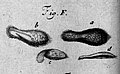 Paramecium from Philosophical Transactions 1703
 -
 Joblot chausson
 -
 Paramecium diagram
 -
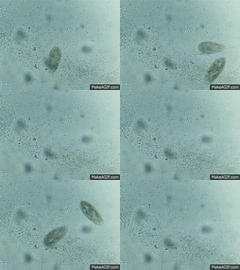 Инфузория туфелька поедает бактерии!
 -
 Stages of ciliate conjugation
 -
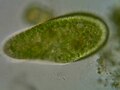 Paramecium bursaria
 -
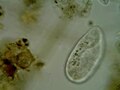 Paramecium putrinum
 -
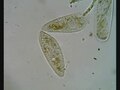 Paramecium Dividing
 -
Conjugation in Paramecium
-
Инфузория туфелька 7


Medical Disclaimer: WikiMD is for informational purposes only and is not a substitute for professional medical advice. Content may be inaccurate or outdated and should not be used for diagnosis or treatment. Always consult your healthcare provider for medical decisions. Verify information with trusted sources such as CDC.gov and NIH.gov. By using this site, you agree that WikiMD is not liable for any outcomes related to its content. See full disclaimer.
Credits:Most images are courtesy of Wikimedia commons, and templates, categories Wikipedia, licensed under CC BY SA or similar.
Translate page: - East Asian
中文,
日本,
한국어,
South Asian
हिन्दी,
தமிழ்,
తెలుగు,
Urdu,
ಕನ್ನಡ,
Southeast Asian
Indonesian,
Vietnamese,
Thai,
မြန်မာဘာသာ,
বাংলা
European
español,
Deutsch,
français,
Greek,
português do Brasil,
polski,
română,
русский,
Nederlands,
norsk,
svenska,
suomi,
Italian
Middle Eastern & African
عربى,
Turkish,
Persian,
Hebrew,
Afrikaans,
isiZulu,
Kiswahili,
Other
Bulgarian,
Hungarian,
Czech,
Swedish,
മലയാളം,
मराठी,
ਪੰਜਾਬੀ,
ગુજરાતી,
Portuguese,
Ukrainian

