Posterior tibial artery
The Posterior Tibial Artery is one of the major arteries of the lower limb. It carries oxygenated blood to the posterior compartment of the leg and plantar surface of the foot. It originates from the Popliteal Artery and ends at the medial and lateral plantar arteries.
Etymology[edit]
The term "Posterior Tibial Artery" is derived from its anatomical position and the bone it runs along. "Posterior" refers to its location at the back of the leg, "Tibial" refers to the Tibia, the larger of the two bones in the lower leg, and "Artery" is from the Latin arteria, meaning a vessel that carries blood from the heart to the body.
Anatomy[edit]
The Posterior Tibial Artery begins at the lower border of the Popliteus Muscle, where it continues from the Popliteal Artery. It extends down the leg, running along the medial side of the Tibia. It then passes behind the medial malleolus, a bony prominence on the inner side of the ankle, and into the foot.
Branches[edit]
The Posterior Tibial Artery gives off several branches, including the Peroneal Artery, Circumflex Fibular Artery, and Muscular Branches. It terminates as the medial and lateral Plantar Arteries, which supply blood to the sole of the foot.
Clinical Significance[edit]
The Posterior Tibial Artery is palpable posterior to the medial malleolus and is commonly used to assess the circulation to the foot, especially in patients with suspected Peripheral Artery Disease. It can also be involved in various conditions such as Aneurysm, Arteriosclerosis, and Thrombosis.
See Also[edit]
- Popliteal Artery
- Tibia
- Peroneal Artery
- Circumflex Fibular Artery
- Plantar Arteries
- Peripheral Artery Disease
- Aneurysm
- Arteriosclerosis
- Thrombosis

This WikiMD article can only be edited by registered and verified editors. You can log in or register.
Posterior_tibial_artery[edit]
-
 Diagram showing the arteries of the lower limb, including the posterior tibial artery.
 -
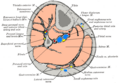 Color illustration of the arteries of the leg, highlighting the posterior tibial artery.
 -
 Labeled diagram of the popliteal artery branches from a posterior view.
 -
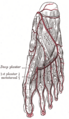 Anatomical illustration of the leg arteries, featuring the posterior tibial artery.


Medical Disclaimer: WikiMD is for informational purposes only and is not a substitute for professional medical advice. Content may be inaccurate or outdated and should not be used for diagnosis or treatment. Always consult your healthcare provider for medical decisions. Verify information with trusted sources such as CDC.gov and NIH.gov. By using this site, you agree that WikiMD is not liable for any outcomes related to its content. See full disclaimer.
Credits:Most images are courtesy of Wikimedia commons, and templates, categories Wikipedia, licensed under CC BY SA or similar.
Translate page: - East Asian
中文,
日本,
한국어,
South Asian
हिन्दी,
தமிழ்,
తెలుగు,
Urdu,
ಕನ್ನಡ,
Southeast Asian
Indonesian,
Vietnamese,
Thai,
မြန်မာဘာသာ,
বাংলা
European
español,
Deutsch,
français,
Greek,
português do Brasil,
polski,
română,
русский,
Nederlands,
norsk,
svenska,
suomi,
Italian
Middle Eastern & African
عربى,
Turkish,
Persian,
Hebrew,
Afrikaans,
isiZulu,
Kiswahili,
Other
Bulgarian,
Hungarian,
Czech,
Swedish,
മലയാളം,
मराठी,
ਪੰਜਾਬੀ,
ગુજરાતી,
Portuguese,
Ukrainian

