Reflex arc
A Reflex arc is a neural pathway that controls a reflex. In vertebrates, most reflex actions are controlled via this pathway. The reflex arc allows an immediate and automatic response to a stimulus, which is essential for survival. The reflex arc comprises five components: the sensory receptor, the sensory neuron, the interneuron, the motor neuron, and the effector.
Components of a Reflex Arc[edit]
Sensory Receptor[edit]
The sensory receptor detects changes in the environment and responds to stimuli.
Sensory Neuron[edit]
The sensory neuron transmits the electrical signal from the sensory receptor to the spinal cord or brain.
Interneuron[edit]
The interneuron processes the information from the sensory neuron and sends a signal to the motor neuron.
Motor Neuron[edit]
The motor neuron carries the signal from the interneuron to the effector.
Effector[edit]
The effector is the muscle or gland that responds to the motor neuron signal, resulting in a reflex action.
Types of Reflex Arcs[edit]
There are two types of reflex arcs: autonomic reflex arc and somatic reflex arc.
Autonomic Reflex Arc[edit]
The autonomic reflex arc affects inner organs, such as regulating heart rate, digestion, and pupil dilation.
Somatic Reflex Arc[edit]
The somatic reflex arc affects muscles, such as causing the withdrawal of a hand from a hot stove.
See Also[edit]

This WikiMD article can only be edited by registered and verified editors. You can log in or register.
Reflex_arc[edit]
-
 Reflex Arc
 -
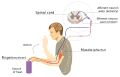 Imgnotraçat Arc Reflex Eng
 -
 Reflex Arc of Decapod Including LG Interneuron


.svg)

Medical Disclaimer: WikiMD is for informational purposes only and is not a substitute for professional medical advice. Content may be inaccurate or outdated and should not be used for diagnosis or treatment. Always consult your healthcare provider for medical decisions. Verify information with trusted sources such as CDC.gov and NIH.gov. By using this site, you agree that WikiMD is not liable for any outcomes related to its content. See full disclaimer.
Credits:Most images are courtesy of Wikimedia commons, and templates, categories Wikipedia, licensed under CC BY SA or similar.
Translate page: - East Asian
中文,
日本,
한국어,
South Asian
हिन्दी,
தமிழ்,
తెలుగు,
Urdu,
ಕನ್ನಡ,
Southeast Asian
Indonesian,
Vietnamese,
Thai,
မြန်မာဘာသာ,
বাংলা
European
español,
Deutsch,
français,
Greek,
português do Brasil,
polski,
română,
русский,
Nederlands,
norsk,
svenska,
suomi,
Italian
Middle Eastern & African
عربى,
Turkish,
Persian,
Hebrew,
Afrikaans,
isiZulu,
Kiswahili,
Other
Bulgarian,
Hungarian,
Czech,
Swedish,
മലയാളം,
मराठी,
ਪੰਜਾਬੀ,
ગુજરાતી,
Portuguese,
Ukrainian

