Rinderpest
Rinderpest (also known as cattle plague or steppe murrain) was an infectious viral disease of cattle, domestic buffalo, and many other species of even-toed ungulates, including buffaloes, large antelope and deer, giraffes, wildebeests, and warthogs.
History[edit]
The disease was characterized by fever, oral erosions, diarrhea, lymphoid necrosis, and high mortality. Death rates during outbreaks were usually extremely high, approaching 100% in immunologically naïve populations. Rinderpest was mainly transmitted by direct contact and by drinking contaminated water, although it could also be transmitted by air. After a global eradication campaign, the last confirmed case of rinderpest was diagnosed in 2001.
Symptoms[edit]
The symptoms of rinderpest were high fever, followed by discharges from the eyes and nose, erosions in the mouth, and diarrhea. The animal would also exhibit a loss of appetite and signs of depression. The disease was usually fatal, with animals dying from dehydration and electrolyte imbalances.
Eradication[edit]
The global eradication of rinderpest was declared in 2011 by the Food and Agriculture Organization and the World Organisation for Animal Health. This followed a decade-long intensive vaccination campaign. Rinderpest is the second disease to have been eradicated, after smallpox.
See also[edit]
- Smallpox
- Infectious disease
- Viral disease
- Food and Agriculture Organization
- World Organisation for Animal Health
References[edit]
External links[edit]
- FAO Rinderpest Home Page
- OIE Rinderpest Portal

This WikiMD article can only be edited by registered and verified editors. You can log in or register.
-
Rinderpest Virus
-
Rinderpest Milk Fever
-
Runderpest in Nederland 18e eeuw
-
Veterinary Report on the cattle plague, 1865-7, Great Britain
-
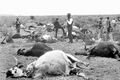 Rinderpest 1896
 -
Political Map of South Africa drawn 1897 reprint 1899
-
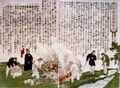 19th century print rinderpest
 -
Animals in action; studies and stories of beasts, birds and reptiles; their habits, their homes and their peculiarities (1901)
-
The National Archives UK - CO 1069-28-39
-
Rinderpest memorial Mukteshwar


Medical Disclaimer: WikiMD is for informational purposes only and is not a substitute for professional medical advice. Content may be inaccurate or outdated and should not be used for diagnosis or treatment. Always consult your healthcare provider for medical decisions. Verify information with trusted sources such as CDC.gov and NIH.gov. By using this site, you agree that WikiMD is not liable for any outcomes related to its content. See full disclaimer.
Credits:Most images are courtesy of Wikimedia commons, and templates, categories Wikipedia, licensed under CC BY SA or similar.
Translate page: - East Asian
中文,
日本,
한국어,
South Asian
हिन्दी,
தமிழ்,
తెలుగు,
Urdu,
ಕನ್ನಡ,
Southeast Asian
Indonesian,
Vietnamese,
Thai,
မြန်မာဘာသာ,
বাংলা
European
español,
Deutsch,
français,
Greek,
português do Brasil,
polski,
română,
русский,
Nederlands,
norsk,
svenska,
suomi,
Italian
Middle Eastern & African
عربى,
Turkish,
Persian,
Hebrew,
Afrikaans,
isiZulu,
Kiswahili,
Other
Bulgarian,
Hungarian,
Czech,
Swedish,
മലയാളം,
मराठी,
ਪੰਜਾਬੀ,
ગુજરાતી,
Portuguese,
Ukrainian


_(14755107632).jpg)

