SDS-PAGE
SDS-PAGE or Sodium dodecyl sulfate polyacrylamide gel electrophoresis is a technique widely used in biochemistry, forensics, genetics, molecular biology and biotechnology to separate proteins according to their electrophoretic mobility (a function of the length of a polypeptide chain and its charge) and no other physical feature.
Overview[edit]
SDS-PAGE is a method that enables the separation of molecules by size. The technique is based on the principle that a charged molecule will migrate in an electric field towards an electrode with opposite sign. The rate of migration of a molecule through a gel is inversely proportional to the logarithm of its size. Therefore, smaller molecules will migrate faster and further than larger molecules.
Procedure[edit]
The procedure of SDS-PAGE can be divided into several steps:
- Sample preparation: The protein sample is mixed with a buffer containing SDS and a reducing agent. The mixture is then heated to denature the proteins.
- Gel preparation: The gel is prepared by polymerizing a mixture of acrylamide and bis-acrylamide.
- Electrophoresis: The samples are loaded into the wells of the gel and an electric current is applied. The proteins migrate towards the positive electrode at a rate proportional to their size.
- Staining: After electrophoresis, the gel is stained to visualize the proteins.
Applications[edit]
SDS-PAGE is used in various fields for different purposes:
- In biochemistry and molecular biology, it is used to determine the molecular weight of proteins and to analyze their relative abundance in different samples.
- In forensics, it is used to compare samples from crime scenes with samples from suspects.
- In biotechnology, it is used to monitor the purity of protein products.
See also[edit]

This WikiMD article can only be edited by registered and verified editors. You can log in or register.
-
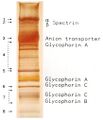 RBC Membrane Proteins SDS-PAGE gel
 -
Protein-SDS interaction
-
 Process of Denaturation
 -
Electrophoresis gel combs
-
Acrylamide gel
-
Disulfide reduction by DTT
-
Gelelektrophorese apparatus
-
SDS-PAGE
-
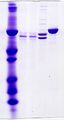 Coomassie
 -
Gel Blue Coomassie


Medical Disclaimer: WikiMD is for informational purposes only and is not a substitute for professional medical advice. Content may be inaccurate or outdated and should not be used for diagnosis or treatment. Always consult your healthcare provider for medical decisions. Verify information with trusted sources such as CDC.gov and NIH.gov. By using this site, you agree that WikiMD is not liable for any outcomes related to its content. See full disclaimer.
Credits:Most images are courtesy of Wikimedia commons, and templates, categories Wikipedia, licensed under CC BY SA or similar.
Translate page: - East Asian
中文,
日本,
한국어,
South Asian
हिन्दी,
தமிழ்,
తెలుగు,
Urdu,
ಕನ್ನಡ,
Southeast Asian
Indonesian,
Vietnamese,
Thai,
မြန်မာဘာသာ,
বাংলা
European
español,
Deutsch,
français,
Greek,
português do Brasil,
polski,
română,
русский,
Nederlands,
norsk,
svenska,
suomi,
Italian
Middle Eastern & African
عربى,
Turkish,
Persian,
Hebrew,
Afrikaans,
isiZulu,
Kiswahili,
Other
Bulgarian,
Hungarian,
Czech,
Swedish,
മലയാളം,
मराठी,
ਪੰਜਾਬੀ,
ગુજરાતી,
Portuguese,
Ukrainian


