Senbei
Senbei (Japanese: 煎餅) are a type of Japanese rice cracker often enjoyed with green tea as a casual snack and offered to visiting house guests as a courtesy refreshment.
History[edit]
Senbei have been enjoyed in Japan for centuries and are believed to have originated from China. They were introduced to Japan around the Yayoi period (300 BC to 300 AD). The original senbei were made from flour, not rice, and it wasn't until the Edo period (1603-1868) that rice was used to make this popular snack.
Types of Senbei[edit]
There are many types of senbei in Japan, varying in both flavor and shape. The most common type is the round, soy-flavored senbei. Other popular types include arare, small bite-sized crackers, and kaki no tane, a spicy, peanut-filled cracker.
Production[edit]
Senbei are made by soaking rice in water, then grinding it into a paste. The paste is then shaped into a round or square form, and grilled or baked. Often, they are brushed with a flavoring sauce, such as soy or miso, and then grilled again to infuse the flavors.
Cultural Significance[edit]
Senbei are often served with tea as a snack in the afternoon. They are also a common gift item and are often presented in decorative boxes. In addition, senbei are often used in various Japanese festivals and events.
See Also[edit]

This Japanese cuisine related article is a stub. You can help WikiMD by expanding it.

Senbei[edit]
-
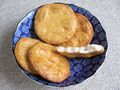 Japanese Senbeis
 -
Senbei 001
-
Senbei 003
-
手焼せんべい 2016
-
Mushasenbei 1
-
Asari Senbei 20170716
-
Nure-senbei 001
-
Katayaki by Kamata Confectionery
-
Nanbu Senbei
-
Yukinoyado 001
-
しぼり焼牡蠣
-
Senbei iro iro


Medical Disclaimer: WikiMD is for informational purposes only and is not a substitute for professional medical advice. Content may be inaccurate or outdated and should not be used for diagnosis or treatment. Always consult your healthcare provider for medical decisions. Verify information with trusted sources such as CDC.gov and NIH.gov. By using this site, you agree that WikiMD is not liable for any outcomes related to its content. See full disclaimer.
Credits:Most images are courtesy of Wikimedia commons, and templates, categories Wikipedia, licensed under CC BY SA or similar.
Translate page: - East Asian
中文,
日本,
한국어,
South Asian
हिन्दी,
தமிழ்,
తెలుగు,
Urdu,
ಕನ್ನಡ,
Southeast Asian
Indonesian,
Vietnamese,
Thai,
မြန်မာဘာသာ,
বাংলা
European
español,
Deutsch,
français,
Greek,
português do Brasil,
polski,
română,
русский,
Nederlands,
norsk,
svenska,
suomi,
Italian
Middle Eastern & African
عربى,
Turkish,
Persian,
Hebrew,
Afrikaans,
isiZulu,
Kiswahili,
Other
Bulgarian,
Hungarian,
Czech,
Swedish,
മലയാളം,
मराठी,
ਪੰਜਾਬੀ,
ગુજરાતી,
Portuguese,
Ukrainian


.jpg)


