Trapezium (bone)
Bone of the wrist
[[File: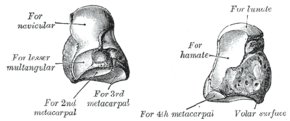 |frameless|alt=]]

| Details | |
|---|---|
| Synonyms | |
| Pronunciation | |
| Carnegie stage | |
| Days | |
| Precursor | |
| Gives rise to | |
| Part of | |
The trapezium (also known as the greater multangular bone) is one of the eight carpal bones of the wrist. It is situated in the distal row of carpal bones and is the most lateral bone in this row. The trapezium is distinguished by its saddle-shaped articular surface, which articulates with the base of the first metacarpal bone (thumb), allowing for the wide range of motion of the thumb.
Anatomy[edit]
The trapezium is a small, irregularly shaped bone with several distinct surfaces:
- The superior surface articulates with the scaphoid bone.
- The inferior surface articulates with the base of the first metacarpal bone.
- The medial surface articulates with the trapezoid bone and the base of the second metacarpal bone.
- The lateral surface is rough and non-articular.
Articulations[edit]
The trapezium articulates with four bones:
- Scaphoid bone (proximally)
- First metacarpal bone (distally)
- Second metacarpal bone (medially)
- Trapezoid bone (medially)
Function[edit]
The trapezium plays a crucial role in the mobility and stability of the thumb. Its saddle-shaped joint with the first metacarpal bone forms the carpometacarpal joint of the thumb, which is a biaxial joint allowing for flexion, extension, abduction, adduction, and opposition of the thumb. This joint is essential for the thumb's wide range of motion and its ability to grasp and manipulate objects.
Clinical significance[edit]
Injuries or conditions affecting the trapezium can significantly impair thumb function. Common issues include:
- Osteoarthritis of the carpometacarpal joint, which can cause pain and reduced mobility.
- Fractures of the trapezium, which may occur due to falls or direct trauma to the wrist.
See also[edit]
References[edit]
 | This human musculoskeletal system article is a stub. You can help WikiMD by expanding the page. |

Medical Disclaimer: WikiMD is for informational purposes only and is not a substitute for professional medical advice. Content may be inaccurate or outdated and should not be used for diagnosis or treatment. Always consult your healthcare provider for medical decisions. Verify information with trusted sources such as CDC.gov and NIH.gov. By using this site, you agree that WikiMD is not liable for any outcomes related to its content. See full disclaimer.
Credits:Most images are courtesy of Wikimedia commons, and templates, categories Wikipedia, licensed under CC BY SA or similar.
Translate page: - East Asian
中文,
日本,
한국어,
South Asian
हिन्दी,
தமிழ்,
తెలుగు,
Urdu,
ಕನ್ನಡ,
Southeast Asian
Indonesian,
Vietnamese,
Thai,
မြန်မာဘာသာ,
বাংলা
European
español,
Deutsch,
français,
Greek,
português do Brasil,
polski,
română,
русский,
Nederlands,
norsk,
svenska,
suomi,
Italian
Middle Eastern & African
عربى,
Turkish,
Persian,
Hebrew,
Afrikaans,
isiZulu,
Kiswahili,
Other
Bulgarian,
Hungarian,
Czech,
Swedish,
മലയാളം,
मराठी,
ਪੰਜਾਬੀ,
ગુજરાતી,
Portuguese,
Ukrainian


01_palmar_view.png)
_-_animation01.gif)
_-_animation02.gif)

