Wrist
Anatomical region of the human body
The wrist is a complex anatomical structure that serves as the transition between the forearm and the hand. It is a crucial component of the upper limb, providing the necessary range of motion and dexterity required for various functions.
Anatomy[edit]
The wrist is composed of multiple bones, joints, ligaments, and tendons that work together to facilitate movement and stability.
Bones[edit]
The wrist contains eight small bones known as the carpal bones. These bones are arranged in two rows:
- The proximal row, which articulates with the radius and ulna of the forearm, includes the scaphoid, lunate, triquetrum, and pisiform.
- The distal row, which articulates with the metacarpal bones of the hand, includes the trapezium, trapezoid, capitate, and hamate.
Joints[edit]
The wrist joint, or radiocarpal joint, is the primary joint of the wrist, formed by the articulation between the distal end of the radius and the proximal row of carpal bones. The ulnocarpal joint is another important joint, involving the ulna and the carpal bones.
Ligaments[edit]
Numerous ligaments stabilize the wrist, including the palmar radiocarpal ligament, dorsal radiocarpal ligament, and the ulnar collateral ligament. These ligaments prevent excessive movement and maintain the alignment of the bones.
Tendons[edit]
The wrist is traversed by tendons from the muscles of the forearm, which control the movements of the wrist and fingers. These include the tendons of the flexor carpi radialis, flexor carpi ulnaris, extensor carpi radialis longus, and extensor carpi ulnaris.
Function[edit]
The wrist allows for a wide range of movements, including:
- Flexion and extension, which enable the hand to move up and down.
- Abduction (radial deviation) and adduction (ulnar deviation), which allow the hand to move side to side.
- Circumduction, a circular movement that combines flexion, extension, abduction, and adduction.
These movements are essential for performing daily activities such as writing, typing, and gripping objects.
Clinical Significance[edit]
The wrist is susceptible to various injuries and conditions, including:
- Carpal tunnel syndrome, a condition caused by compression of the median nerve within the carpal tunnel.
- Wrist fractures, often involving the scaphoid or distal radius.
- Tendonitis, inflammation of the tendons due to overuse or repetitive motion.
Related pages[edit]
Template:Human musculoskeletal system
-
Wrist
-
 3D Medical Animation Human Wrist
 -
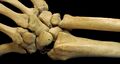 Right Human Posterior Distal Radius Ulna Carpals
 -
Right Human Anterior Distal Radius Ulna Carpals
-
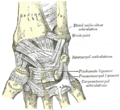 Gray's Anatomy Plate 334
 -
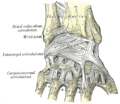 Gray's Anatomy Plate 335
 -
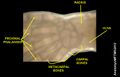 Hand of Embryo
 -
Real-Time MRI during Active Wrist Motion
-
Real-Time MRI during Active Wrist Motion
-
X-ray of Normal Wrist and Wrist with Dorsally Tilted Wrist Joint
-
 Dissection of the Human Hand
 -
 Slide 5


Medical Disclaimer: WikiMD is for informational purposes only and is not a substitute for professional medical advice. Content may be inaccurate or outdated and should not be used for diagnosis or treatment. Always consult your healthcare provider for medical decisions. Verify information with trusted sources such as CDC.gov and NIH.gov. By using this site, you agree that WikiMD is not liable for any outcomes related to its content. See full disclaimer.
Credits:Most images are courtesy of Wikimedia commons, and templates, categories Wikipedia, licensed under CC BY SA or similar.
Translate page: - East Asian
中文,
日本,
한국어,
South Asian
हिन्दी,
தமிழ்,
తెలుగు,
Urdu,
ಕನ್ನಡ,
Southeast Asian
Indonesian,
Vietnamese,
Thai,
မြန်မာဘာသာ,
বাংলা
European
español,
Deutsch,
français,
Greek,
português do Brasil,
polski,
română,
русский,
Nederlands,
norsk,
svenska,
suomi,
Italian
Middle Eastern & African
عربى,
Turkish,
Persian,
Hebrew,
Afrikaans,
isiZulu,
Kiswahili,
Other
Bulgarian,
Hungarian,
Czech,
Swedish,
മലയാളം,
मराठी,
ਪੰਜਾਬੀ,
ગુજરાતી,
Portuguese,
Ukrainian


.jpeg)

