Whale

The whale is a large marine mammal that belongs to the Cetacean order, which also includes dolphins and porpoises. Whales are known for their intelligence, their massive size, and their vocalizations, known as whale songs. They are an important part of marine ecosystems and have a significant cultural and symbolic significance in many societies.
Classification[edit]
Whales are divided into two suborders: the baleen whales (Mysticeti) and the toothed whales (Odontoceti). Baleen whales are characterized by their baleen, a system of filter-feeding plates, and include the largest species of whale, the blue whale. Toothed whales, on the other hand, have teeth and include species such as the sperm whale and the killer whale.
Anatomy and physiology[edit]
Whales have a streamlined body designed for aquatic life. The forelimbs, also known as flippers, are paddle-shaped. The end of the tail holds the fluke, which is used for propulsion. The back of the whale has a dorsal fin.
Whales breathe through blowholes, located on the top of the head so the animal can remain submerged. Baleen whales have two blowholes, while toothed whales have one.
Behavior[edit]
Whales are known for their complex behavior. They can be solitary, but are often found in groups called pods. They communicate using a variety of sounds, including clicks, whistles, and songs.
Conservation[edit]
Many species of whales are threatened or endangered due to human activities such as hunting, pollution, and habitat destruction. Conservation efforts are in place to protect these magnificent creatures.
See also[edit]
References[edit]
External links[edit]

This WikiMD article can only be edited by registered and verified editors. You can log in or register.
Whale[edit]
-
Southern right whale
-
Basilosaurus cetoides
-
Baleen parts
-
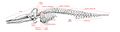 Sperm whale skeleton
 -
Greenland whale
-
 Dolphin


Medical Disclaimer: WikiMD is for informational purposes only and is not a substitute for professional medical advice. Content may be inaccurate or outdated and should not be used for diagnosis or treatment. Always consult your healthcare provider for medical decisions. Verify information with trusted sources such as CDC.gov and NIH.gov. By using this site, you agree that WikiMD is not liable for any outcomes related to its content. See full disclaimer.
Credits:Most images are courtesy of Wikimedia commons, and templates, categories Wikipedia, licensed under CC BY SA or similar.
Translate page: - East Asian
中文,
日本,
한국어,
South Asian
हिन्दी,
தமிழ்,
తెలుగు,
Urdu,
ಕನ್ನಡ,
Southeast Asian
Indonesian,
Vietnamese,
Thai,
မြန်မာဘာသာ,
বাংলা
European
español,
Deutsch,
français,
Greek,
português do Brasil,
polski,
română,
русский,
Nederlands,
norsk,
svenska,
suomi,
Italian
Middle Eastern & African
عربى,
Turkish,
Persian,
Hebrew,
Afrikaans,
isiZulu,
Kiswahili,
Other
Bulgarian,
Hungarian,
Czech,
Swedish,
മലയാളം,
मराठी,
ਪੰਜਾਬੀ,
ગુજરાતી,
Portuguese,
Ukrainian


.jpg)

