African tick bite fever
| African tick bite fever | |
|---|---|
| African tick bite fever lesion on leg | |
| Synonyms | N/A |
| Pronounce | N/A |
| Specialty | N/A |
| Symptoms | Fever, headache, muscle pain, rash, eschar |
| Complications | Rarely neurological complications |
| Onset | 5 to 7 days after tick bite |
| Duration | Usually self-limiting within 2 weeks |
| Types | N/A |
| Causes | Rickettsia africae |
| Risks | Tick exposure in endemic areas |
| Diagnosis | Serology, PCR testing |
| Differential diagnosis | Malaria, typhoid fever, other rickettsial infections |
| Prevention | Avoiding tick bites, using insect repellent |
| Treatment | Doxycycline |
| Medication | N/A |
| Prognosis | Generally good with treatment |
| Frequency | Common in travelers to sub-Saharan Africa |
| Deaths | N/A |
African tick bite fever is an infectious disease caused by the bacterium Rickettsia africae. It is transmitted to humans through the bite of infected ticks, primarily of the Amblyomma genus. This disease is part of the spotted fever group of rickettsial infections.
Etiology[edit]
The causative agent of African tick bite fever is Rickettsia africae, a gram-negative, obligate intracellular bacterium. It is transmitted by ticks of the Amblyomma genus, particularly Amblyomma variegatum and Amblyomma hebraeum.
Epidemiology[edit]
African tick bite fever is endemic in sub-Saharan Africa and the Caribbean. It is considered a common travel-associated infection for individuals visiting rural areas in these regions. The disease is often reported in travelers returning from safaris or hiking trips.
Clinical Presentation[edit]
The incubation period for African tick bite fever is typically 5 to 7 days. The disease is characterized by the sudden onset of fever, headache, muscle pain, and a distinctive skin rash. A key feature is the presence of an eschar at the site of the tick bite, which is a necrotic lesion surrounded by a red halo.
Diagnosis[edit]
Diagnosis of African tick bite fever is primarily clinical, based on the presence of fever, rash, and eschar in a patient with a history of tick exposure in endemic areas. Laboratory confirmation can be achieved through serological tests or polymerase chain reaction (PCR) assays to detect Rickettsia africae DNA.
Treatment[edit]
The treatment of choice for African tick bite fever is doxycycline, an antibiotic effective against rickettsial infections. Treatment typically leads to rapid resolution of symptoms.
Prevention[edit]
Preventive measures include avoiding tick-infested areas, using insect repellents, wearing protective clothing, and performing regular tick checks after potential exposure. Travelers to endemic regions should be educated about the risks and preventive strategies.
Related Pages[edit]
Gallery[edit]
-
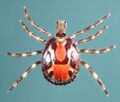 Amblyomma variegatum male
 -
Amblyomma hebraeum


Medical Disclaimer: WikiMD is for informational purposes only and is not a substitute for professional medical advice. Content may be inaccurate or outdated and should not be used for diagnosis or treatment. Always consult your healthcare provider for medical decisions. Verify information with trusted sources such as CDC.gov and NIH.gov. By using this site, you agree that WikiMD is not liable for any outcomes related to its content. See full disclaimer.
Credits:Most images are courtesy of Wikimedia commons, and templates, categories Wikipedia, licensed under CC BY SA or similar.
Translate page: - East Asian
中文,
日本,
한국어,
South Asian
हिन्दी,
தமிழ்,
తెలుగు,
Urdu,
ಕನ್ನಡ,
Southeast Asian
Indonesian,
Vietnamese,
Thai,
မြန်မာဘာသာ,
বাংলা
European
español,
Deutsch,
français,
Greek,
português do Brasil,
polski,
română,
русский,
Nederlands,
norsk,
svenska,
suomi,
Italian
Middle Eastern & African
عربى,
Turkish,
Persian,
Hebrew,
Afrikaans,
isiZulu,
Kiswahili,
Other
Bulgarian,
Hungarian,
Czech,
Swedish,
മലയാളം,
मराठी,
ਪੰਜਾਬੀ,
ગુજરાતી,
Portuguese,
Ukrainian


