Culdocentesis
Culdocentesis is a medical procedure that involves the puncture and aspiration of fluid from the pouch of Douglas (also known as the rectouterine pouch). This procedure is typically performed when a healthcare provider suspects that a patient may have a pelvic inflammatory disease (PID) or an ectopic pregnancy.
Procedure[edit]
Culdocentesis is usually performed in a hospital or clinic setting. The patient is placed in the lithotomy position, with her legs bent and feet in stirrups. The healthcare provider then inserts a needle through the vaginal wall, into the pouch of Douglas. If fluid is present, it can be aspirated and sent to a lab for analysis.
Indications[edit]
Culdocentesis may be performed when a healthcare provider suspects that a patient has a PID or an ectopic pregnancy. It can also be used to detect ovarian cyst rupture or hemoperitoneum (blood in the peritoneal cavity).
Risks and Complications[edit]
As with any invasive procedure, culdocentesis carries some risks. These may include infection, bleeding, and injury to surrounding organs. In rare cases, the procedure may cause a small hole (perforation) in the uterus or bowel.
Alternatives[edit]
While culdocentesis can be a useful diagnostic tool, there are other methods available that may be less invasive and carry fewer risks. These include ultrasound imaging and laparoscopy.
See Also[edit]
 | This medical article is a stub. You can help WikiMD by expanding the page. |
Culdocentesis[edit]
-
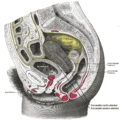 Culdocentesis


Medical Disclaimer: WikiMD is for informational purposes only and is not a substitute for professional medical advice. Content may be inaccurate or outdated and should not be used for diagnosis or treatment. Always consult your healthcare provider for medical decisions. Verify information with trusted sources such as CDC.gov and NIH.gov. By using this site, you agree that WikiMD is not liable for any outcomes related to its content. See full disclaimer.
Credits:Most images are courtesy of Wikimedia commons, and templates, categories Wikipedia, licensed under CC BY SA or similar.
Translate page: - East Asian
中文,
日本,
한국어,
South Asian
हिन्दी,
தமிழ்,
తెలుగు,
Urdu,
ಕನ್ನಡ,
Southeast Asian
Indonesian,
Vietnamese,
Thai,
မြန်မာဘာသာ,
বাংলা
European
español,
Deutsch,
français,
Greek,
português do Brasil,
polski,
română,
русский,
Nederlands,
norsk,
svenska,
suomi,
Italian
Middle Eastern & African
عربى,
Turkish,
Persian,
Hebrew,
Afrikaans,
isiZulu,
Kiswahili,
Other
Bulgarian,
Hungarian,
Czech,
Swedish,
മലയാളം,
मराठी,
ਪੰਜਾਬੀ,
ગુજરાતી,
Portuguese,
Ukrainian

