Diquat
Diquat is a contact herbicide that rapidly desiccates the leaves of plants upon exposure. It is used in agriculture and horticulture to control a wide range of weed species. Diquat is also used in aquatic environments to control nuisance aquatic vegetation.
Chemistry[edit]
Diquat is a bipyridyl herbicide. The chemical formula of diquat is C12H12Br2N2. It is a yellow to brown liquid with a sharp odor. Diquat is highly soluble in water and is not volatile. It is stable under normal storage conditions.
Mode of Action[edit]
Diquat acts by interfering with photosynthesis, the process by which plants convert sunlight into chemical energy. It is a non-selective herbicide, meaning it will kill most plants it comes into contact with. Diquat is rapidly absorbed by plant tissues and is translocated within the plant but not to a great extent.
Health Effects[edit]
Exposure to diquat can cause irritation to the skin and eyes. Ingestion can cause nausea, vomiting, and diarrhea. Long-term exposure can lead to more serious health effects such as damage to the liver and kidneys.
Environmental Impact[edit]
Diquat is highly toxic to aquatic organisms. It can also be harmful to non-target plants if it drifts from the area where it is applied. However, diquat binds tightly to soil particles and is not likely to leach into groundwater.
Regulation[edit]
In the United States, diquat is classified as a Restricted Use Pesticide (RUP) by the Environmental Protection Agency (EPA). This means that it can only be purchased and used by certified applicators.
See Also[edit]

 | This medical article is a stub. You can help WikiMD by expanding the page. |
Diquat[edit]
-
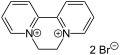 Structural formula of Diquat
 -
3D ball model of Diquat dibromide
-
Synthesis of Diquat
-
Use of Diquat in the USA


Medical Disclaimer: WikiMD is for informational purposes only and is not a substitute for professional medical advice. Content may be inaccurate or outdated and should not be used for diagnosis or treatment. Always consult your healthcare provider for medical decisions. Verify information with trusted sources such as CDC.gov and NIH.gov. By using this site, you agree that WikiMD is not liable for any outcomes related to its content. See full disclaimer.
Credits:Most images are courtesy of Wikimedia commons, and templates, categories Wikipedia, licensed under CC BY SA or similar.
Translate page: - East Asian
中文,
日本,
한국어,
South Asian
हिन्दी,
தமிழ்,
తెలుగు,
Urdu,
ಕನ್ನಡ,
Southeast Asian
Indonesian,
Vietnamese,
Thai,
မြန်မာဘာသာ,
বাংলা
European
español,
Deutsch,
français,
Greek,
português do Brasil,
polski,
română,
русский,
Nederlands,
norsk,
svenska,
suomi,
Italian
Middle Eastern & African
عربى,
Turkish,
Persian,
Hebrew,
Afrikaans,
isiZulu,
Kiswahili,
Other
Bulgarian,
Hungarian,
Czech,
Swedish,
മലയാളം,
मराठी,
ਪੰਜਾਬੀ,
ગુજરાતી,
Portuguese,
Ukrainian


