Fish fillet
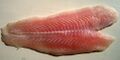
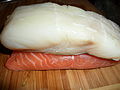
Fish fillet is a piece of fish that has been cut or sliced away from the bone by cutting lengthwise along one side of the fish parallel to the backbone. In preparation for filleting, any scales on the fish should be removed. The contents of the stomach also need careful detaching from the fillet. Fish fillets are generally free from bones and thus are often preferred in the western kitchen.
Types of Fillets[edit]
There are several types of cuts of fish fillets, including Cutlet, Supreme cut and Tronçon. A fish fillet, from the French word filet /filɛ/ meaning a thread or strip, is the flesh of a fish which has been cut or sliced away from the bone by cutting lengthwise along one side of the fish parallel to the backbone.
Fish Filleting[edit]
The process of filleting a fish is relatively simple once the steps are understood. To fillet a fish, it is necessary to cut the fish on either side of the spine and remove it by cutting underneath the flesh. The fillet is then flipped over and the same process is repeated on the other side.
Health Benefits[edit]
Fish fillets, particularly from salmon, tuna, and mackerel, are rich in omega-3 fatty acids, which are heart-healthy. They also provide a good source of protein and vitamin D.
Cooking Methods[edit]
Fish fillets can be cooked in a variety of ways, including grilling, baking, broiling, and frying. They can also be used in a variety of dishes, such as fish and chips, fish tacos, and fish curry.
See Also[edit]

This WikiMD article can only be edited by registered and verified editors. You can log in or register.
-
 Fish fillet
 -
Fish fillet
-
Fish fillet
-
Fish fillet
-
Fish fillet
-
Fish fillet
-
Fish fillet
-
Fish fillet
-
 Fish fillet
 -
Fish fillet
-
 Fish fillet
 -
Fish fillet


Medical Disclaimer: WikiMD is for informational purposes only and is not a substitute for professional medical advice. Content may be inaccurate or outdated and should not be used for diagnosis or treatment. Always consult your healthcare provider for medical decisions. Verify information with trusted sources such as CDC.gov and NIH.gov. By using this site, you agree that WikiMD is not liable for any outcomes related to its content. See full disclaimer.
Credits:Most images are courtesy of Wikimedia commons, and templates, categories Wikipedia, licensed under CC BY SA or similar.
Translate page: - East Asian
中文,
日本,
한국어,
South Asian
हिन्दी,
தமிழ்,
తెలుగు,
Urdu,
ಕನ್ನಡ,
Southeast Asian
Indonesian,
Vietnamese,
Thai,
မြန်မာဘာသာ,
বাংলা
European
español,
Deutsch,
français,
Greek,
português do Brasil,
polski,
română,
русский,
Nederlands,
norsk,
svenska,
suomi,
Italian
Middle Eastern & African
عربى,
Turkish,
Persian,
Hebrew,
Afrikaans,
isiZulu,
Kiswahili,
Other
Bulgarian,
Hungarian,
Czech,
Swedish,
മലയാളം,
मराठी,
ਪੰਜਾਬੀ,
ગુજરાતી,
Portuguese,
Ukrainian


