Horse meat
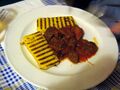
Horse meat is the culinary name for meat cut from a horse. It is a major meat in only a few countries, notably in Central Asia, but it forms a significant part of the culinary traditions of many others, from Europe to South America to Asia. The top eight countries consume about 4.7 million horses a year. For the majority of humanity's early existence, wild horses were hunted as a source of protein.
Etymology[edit]
The word for "horse" in the early Indo-European languages is *h₁réǵs. It derives from Proto-Indo-European *h₁réǵs and is cognate with Old Irish réc, Greek ἵππος (hippos), Latin equus, Lithuanian ašvà and Mycenaean Greek i-qo.
Culinary traditions[edit]
Horse meat forms a significant part of the culinary traditions of many countries, from Europe to South America to Asia. The top eight countries consume about 4.7 million horses a year.
Kazakhstan and Kyrgyzstan[edit]
In Kazakhstan and Kyrgyzstan, horse meat is a large part of the diet, due mainly to the nomadic roots of the population. Some of the dishes include sausages and a delicacy known as beshbarmak.
Related terms[edit]
- Beshbarmak: A national dish of Kazakhstan and Kyrgyzstan, traditionally made with boiled meat (often horse meat), served over pasta.
- Sausages: A food usually made from ground meat, often pork, beef, or poultry, along with salt, spices and other flavorings.
See also[edit]
References[edit]

This WikiMD article can only be edited by registered and verified editors. You can log in or register.
-
 Horse_meat
 -
Horse_meat
-
Horse_meat
-
 Horse_meat
 -
 Horse_meat
 -
Horse_meat
-
Horse_meat
-
Horse_meat
-
 Horse_meat
 -
 Horse_meat
 -
 Horse_meat
 -
Horse_meat


Medical Disclaimer: WikiMD is for informational purposes only and is not a substitute for professional medical advice. Content may be inaccurate or outdated and should not be used for diagnosis or treatment. Always consult your healthcare provider for medical decisions. Verify information with trusted sources such as CDC.gov and NIH.gov. By using this site, you agree that WikiMD is not liable for any outcomes related to its content. See full disclaimer.
Credits:Most images are courtesy of Wikimedia commons, and templates, categories Wikipedia, licensed under CC BY SA or similar.
Translate page: - East Asian
中文,
日本,
한국어,
South Asian
हिन्दी,
தமிழ்,
తెలుగు,
Urdu,
ಕನ್ನಡ,
Southeast Asian
Indonesian,
Vietnamese,
Thai,
မြန်မာဘာသာ,
বাংলা
European
español,
Deutsch,
français,
Greek,
português do Brasil,
polski,
română,
русский,
Nederlands,
norsk,
svenska,
suomi,
Italian
Middle Eastern & African
عربى,
Turkish,
Persian,
Hebrew,
Afrikaans,
isiZulu,
Kiswahili,
Other
Bulgarian,
Hungarian,
Czech,
Swedish,
മലയാളം,
मराठी,
ਪੰਜਾਬੀ,
ગુજરાતી,
Portuguese,
Ukrainian


